
ESG is smart business.
AND
It transforms the way we do business.
For companies to evolve and scale in today’s competitive environment, an ESG (Environmental, Governance, Social) strategy backed by powerful, robust data is a must-have.
In the past, a company’s commitment to “do good” was an ancillary, immeasurable goal. Now with an abundance of ESG data available, ESG impact is both measurable and in high demand by stakeholders and consumers. ESG goals now have an equal seat at the table alongside other revenue producing KPIs.
ESG data is plentiful, but complex. And there are handfuls of reasons why these metrics matter to the leaders in the boardroom, their stakeholders, and their customers.
Let’s unpack ESG Data.
The What.
The Why.
and The How.
What is ESG Data?
Environmental, Governance, and Social are the three components that make up ESG. Companies use these guide posts to determine their impact on the environment and society. Measuring ESG data is a way for companies to establish transparency and accountability with stakeholders – investors, customers, and employees. There are numerous data points to consider, but these are a few examples:
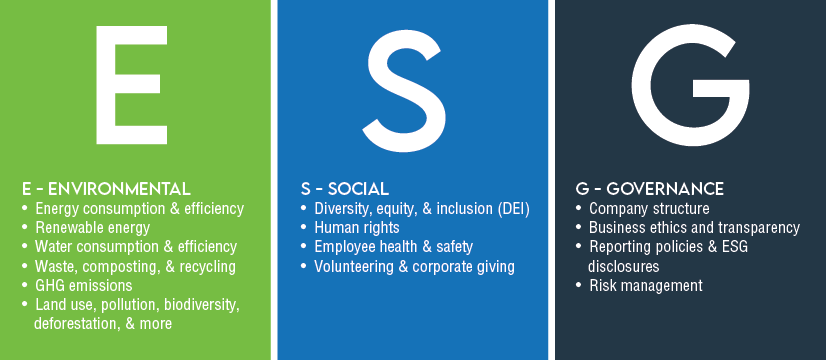
ESG evaluations and scores, when combined with financial analysis, give investors a clear understanding of a company’s long-term potential. These data points identify key issues that aren’t typically accounted for on a traditional balance sheet, yet have a critical impact on a company’s risks and opportunities.
Why ESG Data?
“Today’s leaders are faced with an incredible opportunity to carve out a new future for their organizations by building sustainability principles into core business strategies.”
Once considered subjective, “feel good” data, ESG data provides a clear snapshot of a company’s performance and impact on the environment and society. Now more than ever before, stakeholders care deeply about partnering with businesses who care about the same issues they do.
Millennials in particular are committed to working for and purchasing from value-driven companies. With an annual spend of $2.5 trillion (and growing), consumer power is making it a necessity for companies to “stay ahead of the curve” by providing clear and transparent ESG data.
Collecting and analyzing ESG data helps companies maintain compliance and realize inefficiencies in their operations
ESG is no longer a “nice to have,” but a “must have.”, especially now that government agencies are beginning to require reporting of such data.
How do I track and collect my ESG data?
To start, energy, water, and waste data in particular helps to tell the story of a company’s current environmental impact.
These metrics unlock solutions that improve the way companies operate while simultaneously supporting their bottom line. One fundamental data point that any business operating properties should track is the utility usage at their locations. Understanding the actual consumption of utilities at a building is the first step in revealing where usage, including GHG emissions, can be reduced. For real estate owners and managers, this information is crucial in determining where retrofits are necessary and in tracking the cost-to-benefit ratio of implementing changes.
Tracking and analyzing environmental data is made easier when partnering with an environmental management system (EMS) provider. An EMS provider can assist with comprehending this data through utility bill collection or connecting to smart meters, which capture real-time utility usage directly from a property.
Launched in 1992, ENERGY STAR is a voluntary EPA program that delivers environmental benefits and financial value through superior energy efficiency. In 2019, the ENERGY STAR program for commercial buildings helped businesses and organizations save 230 billion kilowatt-hours of electricity, avoid $14 billion in energy costs, and achieve 170 million metric tons of greenhouse gas reductions.
Social (the “S” in ESG) data can also be tracked, allowing a company to fully grasp its impact on its stakeholders. This data is typically collected through surveys conducted by a third independent party and can include a variety of metrics depending on the key performance indicator(s) a company would like to measure. For example, individuals can be prompted to provide a net promoter score (NPS) and satisfaction score to gauge satisfaction of a group. For health and well being, assessing needs and goals can assist a company in improving its social impact on stakeholders.
Third party assurance providers ensure all reported data is accurate as disclosed. For example, such verification can support a company’s innocence of greenwashing (a form of misinformation or deceptive marketing to gain investors or stakeholders by falsely presenting that the company’s operations are eco-friendly).
Your Data, Our Solution
As investors become focused on understanding and evaluating ESG performance and consumer spending shifts toward sustainability-focused enterprises, businesses are seeking out solutions to gather and report on metrics that show solid management of ESG (Environmental, Social, Governance) efforts and outcomes. However, managing an ESG program and evaluating performance can be a complex challenge which requires accurate, relevant, current data that must be collected, analyzed, and disclosed.
To do this, many companies are turning to EMS providers that help businesses monitor non-renewable resources, minimize usage and harmful emissions and waste, reduce operational costs, and support regulatory compliance.
To support the demand from standardized ESG and reporting frameworks, the World Economic Forum unveiled a set of metrics companies can use in reporting methodology that provides a common set of disclosures and support more coherent, comprehensive ESG reporting systems.
Conservice ESG partners with companies across all verticals of the real estate industry. With the only bill to boardroom solution in our industry, we create and implement ESG strategies that impact the world while growing a company’s bottom line. Learn more and schedule a demo
Make an impact, create positive change. Together.
About Conservice ESG
Your utility data is a key ingredient for improving your ESG performance & uncovering actionable insights that will save you time & money.
Conservice ESG combines industry-leading utility automation, a powerful ESG platform, and consulting expertise. We provide an end-to-end solution that will help you improve operations, engage stakeholders, and attract investors. Learn more about Conservice ESG here.



Subscribe To Our Blog Newsletter
Keep yourself ahead of the curve with the latest utility news, trends, & resources.
Editor's Picks

The How-to Guide for Reducing CAM Charges and Shared Space Costs
TL;DR When investigating where to reduce CAM charges and multifamily common-area costs, shared utility expenses might be the place to start. A higher bill doesn’t automatically signal waste, so it’s important to compare cost and consumption before deciding where to…

Installing EV Charging Stations: A Guide for Multifamily Property Owners
Have there always been this many electric vehicles on the road? It looks like the silent hum of an EV has become a roar, as Electric vehicles take the United States by storm. With the rise of EVs, comes the…

Policy Watch: Compliance & Building Readiness with Brett Kraus and Michelle Winters
Policy Watch: Compliance & Building Readiness with | RSS.com In this episode of Utility Wisdom, Michelle Winters, Vice President of Sustainability Sales at Conservice, sits down with Brett Kraus, Senior Legal Counsel, and Katie Piel, Sustainability Manager, to break down…
Conservice Earns 15th Appearance on Inc. 5000
RIVER HEIGHTS, Utah, August 14, 2026 – Conservice, the nation’s leading utility management provider, has been named to the 2026 Inc. 5000, marking the company’s 15th appearance on the annual list of America’s fastest-growing private companies. The recognition adds another…

5 Signs Your Telecom Strategy Needs An Update
Telecom has a funny way of becoming someone’s problem. A resident can’t get connected, so they call the onsite property team. A provider needs an answer, so someone digs through an old agreement. A renewal date appears on the calendar,…

How to Streamline Invoice Processing & Auditing
Utility bills have a lot to say. They can tell you where costs are climbing and where usage looks unusual. They can point to a provider error before it hits your bottom line. And across hundreds or thousands of accounts,…

Ask An Expert with Sustainability Expert, Sandra Closson
Meet Sandra Closson Some people see spreadsheets full of utility data. Sandra sees a story about how a building operates and where it can improve. With nearly three decades of professional experience and 17 years in sustainability, Sandra has built…

The Next Chapter of Single Family Operations
At some point “more” stops being the answer. The single family industry has spent the last decade defining success as growth. Build new properties, acquire existing properties, attract institutional investment, repeat. Portfolios grew from hundreds of homes to thousands. “More”…

RUBS Utility Billing vs. Submetering: A Decision Guide
RUBS Utility Billing vs. Submetering A Decision Gu | RSS.com TL;DR: Not every property gets to choose between RUBS and submetering – your building, budget, and state regulations all play a role. RUBS (Ratio Utility Billing System) is faster and…

NAA 2026 Debrief: AI Everywhere, Automation Under Pressure, and the Human Work of Multifamily
NAA 2026 Debrief: AI Everywhere, Automation Under | RSS.com Attending this year’s Apartmentalize (which was truly excellent, by the way), you couldn’t help but notice a contrast. On the one hand, the vendor floor was an absolute sea of AI…
Experience Effortless Utility Management and Cost Savings
Connect with us today to discover how our solutions can ease tenant billback, streamline utility management, and reduce your costs and energy usage. Make your utility management smarter and more efficient with Conservice!