
If an investor asked you tomorrow which markets in your portfolio carry the most physical climate exposure (and what you are doing about it), could you answer clearly?
For many multifamily teams, the honest answer is “not yet.”
The focus of climate risk analysis has moved from reflexive sustainability reporting to material investment conversations. Investors are asking how it affects underwriting, lenders examining financing assumptions, and boards want to know whether geographic concentrations introduce avoidable exposure.
The challenge is not a lack of information. It is a lack of structure.
The Real Problem? Exposure Lists Don’t Drive Decisions
Physical climate risk is broad by definition.
Heat waves strain building systems.
Heavy precipitation increases operational stress and repair frequency.
Wildfire conditions affect insurability.
River floods and storm surges can create loss events.
Sea level rise introduces long-term market implications.
When you review hazard outputs asset by asset, the data quickly becomes overwhelming. Nearly every property shows exposure to something.
What many portfolio teams need is a practical way to screen exposure across assets and decide where to look deeper.
A Simple Way to Think About Climate Risk Assessment
In late 2024, ASTM formalized a structured approach to Property Resilience Assessments. While the technical guidance is detailed, the high-level concept is straightforward:
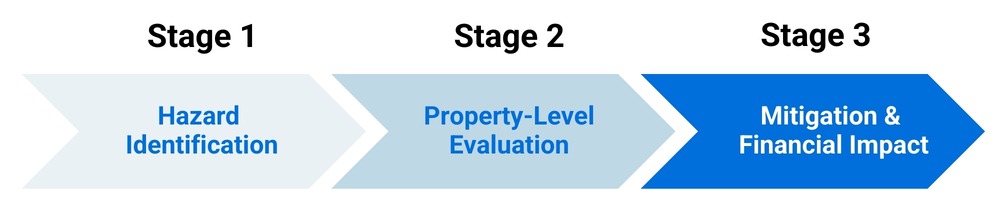
For most portfolios, the screening stage (Stage 1) is where clarity begins.
What Good Screening Looks Like
Effective screening does not require heavy financial modeling. But it does require thoughtful analysis.
A practical Stage 1 screening approach includes:
- Defining the population of assets you want to evaluate.
- Selecting the hazards to assess.
- Choosing a timeline aligned with hold periods and financing realities.
- Defining what “exposed” means in your analysis.
- Adding a monetary lens so exposure can be compared across markets.
- Looking for concentration, not just presence.
The goal is prioritization.
Which markets or properties deserve a closer look?
Which ownership entities are concentrated in higher-risk geographies?
Which individual assets represent a disproportionate share of exposed value?
When screening is structured, those answers become visible quickly.
The Hazards Shaping Multifamily Performance
In our latest assessment, Rent at Risk, Conservice Sustainability Solutions examined physical climate exposure across eight hazard types:


Each hazard behaves differently and has unique stressors that increase operating costs and strain systems over time. Some are acute events that can drive sudden capital impacts or insurance disruption.
Together, these eight form the physical risk landscape that multifamily investors must now evaluate.
What We Analyzed in Rent at Risk
To better understand the scale and distribution of exposure, the Conservice Sustainability Solutions team analyzed climate hazard data across a large set of investment-grade multifamily properties.
The goal was not to predict losses, but rather to answer three practical questions:
- How widespread is physical climate exposure in multifamily real estate?
- How is that exposure distributed across markets and ownership structures?
- How can portfolio teams translate exposure into a financial lens without building complex damage models?
One directional finding stands out: physical exposure is not isolated to a handful of coastal markets. It is widespread and often concentrated in places that receive less attention.
But exposure alone does not tell you where to act.
Exposure Needs a Financial Lens
Consider two properties exposed to the same hazard.
If one represents 3% of a portfolio’s value and the other represents 15%, the portfolio implications are very different.
Similarly, a market with moderate hazard exposure but very high property values can represent a larger financial concentration of risk than a market with lower asset values.
By layering exposure with a consistent value proxy and comparing concentrations across markets and ownership entities, portfolio teams can identify “hotspots” — areas where deeper property-level assessment makes sense.
In Rent at Risk, we outline a practical way to apply this lens across thousands of units without relying on opaque calculators.
From Screening to Action
A structured screening process does not replace engineering studies or resilience planning, but it informs them.
Once exposure concentrations are identified, portfolio teams can:
- Prioritize assets for detailed resilience assessments.
- Review insurance coverage in higher-exposure markets.
- Evaluate geographic diversification strategies.
- Incorporate climate considerations into capital planning.
Most importantly, screening allows leadership teams to answer investor questions with clarity and consistency.
Start with Clarity
Physical climate risk is now part of prudent portfolio management. If your team needs a practical framework for screening exposure across markets and assets, and a way to translate that exposure into a financial perspective, we invite you to download:
Rent at Risk: Assessing Physical Climate Risk in Multifamily Investments
The guide includes:
- The full screening methodology.
- Hazard exposure findings across thousands of properties.
- A structured approach to identifying portfolio hotspots.
- Recommendations for moving from screening to property-level action.



Subscribe To Our Blog Newsletter
Keep yourself ahead of the curve with the latest utility news, trends, & resources.
Editor's Picks

Navigating Today’s Connectivity Landscape with Nic Arri
Navigating Today’s Connectivity Landscape with Nic | RSS.com The connectivity landscape is getting more complex, and multifamily owners and operators have some big decisions to make. We sat down with Nic Arri, Vice President of Solutions Consulting at Conservice, to…
Broadband & Beyond with Kevin Donnelly
Broadband & Beyond with Kevin Donnelly | RSS.com What’s next for broadband in multifamily? We sat down with Kevin Donnelly of the Real Estate Technology and Transformation Center (RETTC) to discuss the evolving landscape of multifamily connectivity. They explore the…
The Utility Partnership Playbook with Jeff Smedley & Scott Hines
The Utility Partnership Playbook with Jeff Smedley | RSS.com Who manages the utilities at a senior living community? Often, it’s a business manager or bookkeeper who is also juggling resident enrollment, retention, and day-to-day community operations. Lauren Howard sits down…

Utility Theft Detection: Protecting Revenue with Smart Monitoring
What does a case of “utility theft” even look like? A broken meter? A cyber attack? Someone hotwiring an electric panel like it’s some kind of car? Utility theft is a broad term for a simple concept—the loss of recoverable…

The Only 5 Utility Management Companies Worth Considering in 2026
The multifamily utility market has no shortage of providers. But only a handful offer the scale, service depth, technology, or specialization to deserve serious consideration in 2026. Five stand out: Conservice (unashamed plug, but true is true), RealPage, Yardi, Entrata,…

Why Should You Centralize Your Utility Management?
TL;DR Ever hear the saying “you need to get your ducks in a row”? That can be a difficult ask when those ducks are running in different directions, across multiple states. Some are even hiding from you, with a few…

Broadband Summit 2026 Debrief: The Infrastructure of Connectivity
Telecom strategy used to be limited to a few baseline questions: Who is the provider? What speeds do they offer? And are they offering the best rate? That was often the extent of the decision-making process. Walking out of Broadband…
Scaling Senior Living with Justin Brady
Scaling Senior Living with Justin Brady | RSS.com Who manages the utilities at a senior living community? Often, it’s a business manager or bookkeeper who is also juggling resident enrollment, retention, and day-to-day community operations. Lauren Howard sits down with…

Rental Junk Fee Laws in 2026: What Utility Billing Teams Need to Know
TL;DR: Fee transparency law is tightening in 2026, and most of the new rules target disclosure, not the formulas billing teams use to calculate a utility bill-back. This guide breaks down what counts as a junk fee, where disclosure rules…

Conservice’s 2nd Annual 5K Brings Together More Than 500 Participants and Gives Back to Cache Valley
LOGAN, Utah — September 10, 2026 — Conservice celebrated its second annual 5K Fun Run on September 9, bringing employees, families, and community partners together for an afternoon of connection and giving back. More than 550 people registered for this…
Experience Effortless Utility Management and Cost Savings
Connect with us today to discover how our solutions can ease tenant billback, streamline utility management, and reduce your costs and energy usage. Make your utility management smarter and more efficient with Conservice!