
Each year, NAA Apartmentalize is split down the middle into two loud worlds: the vendor floor and the breakout sessions. On the vendor floor, you’ll be confronted by everything from rent optimization platforms to emotional support duck registration tools. It’s an awesome circus of opportunities, vendors, and so, so much swag. If you attended, we hope you stopped by our big beautiful booth, nabbed a drink, and let one of our Utility Experts hawk our wares at you.
But it’s the Apartmentalize sessions, that rich collection of panel discussions, presentations, and demonstrations, that are the focus of this article. Every year, we send out a small army of content experts to sleuth the various sessions and pocket away insights to collect in this article. It’s a rare moment when the multifamily industry comes together to itself about itself, and as a fundamental part of that industry from one coast to the other, it’s our responsibility to stay on top of and ahead of the trends impacting our customers.
The trends in question?
- The maturing of Build-to-Rent (BTR) as a rental product
- The AI-resident overload dilemma and how teams are adapting
- The evolving (and politically complicated) need for ESG credibility
Here’s what we learned.
BTR Hits Puberty: Growing Pains and Big Potential
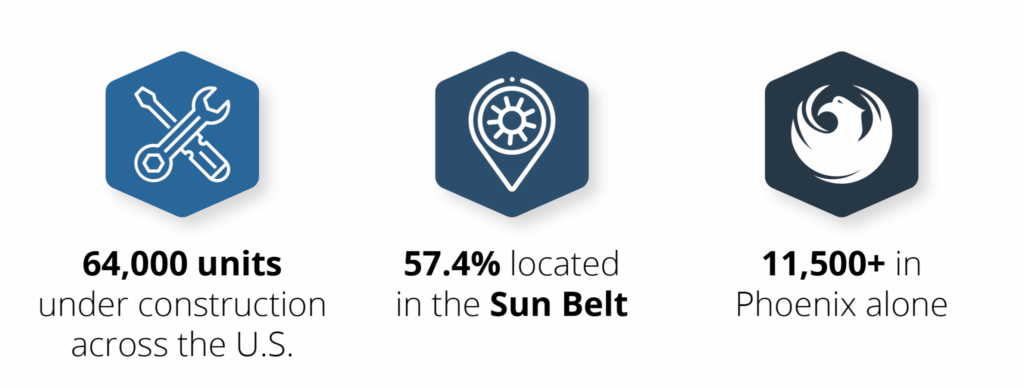
Fundamentally, Build-to-Rent is still a small fraction of the rental housing market, making up just 2% of market-rate product at the time of writing. Its growth, however, has been disproportionately fast and increasingly visible in the Sun Belt and secondary markets. As of June 2025, approximately 64,000 BTR units are under construction across the U.S., with the Sun Belt accounting for 57.4% of those builds. Phoenix alone has over 11,500 BTR units in development, highlighting a clear geographic center of gravity for this trend.
BTR Stat Snapshot (June 2025)
What became clear at the various NAA sessions we attended is that BTR isn’t really one thing. It’s a broad category encompassing single-family homes, cottage-style horizontal apartments, and multi-level townhomes. On the one hand, that variety engenders a lot of opportunity across a broad range of business structures and portfolio sizes. On the other hand, it could (and has) led to a lot of confusion for the marketing teams, leasing operations, and investors interested in leveraging BTR as a growth strategy.
The Unique Operational Challenges of BTR
Here’s a high-level summary of the BTR’s key challenges aggregated from our three days at NAA:
- Utility costs scale fast in two-level and detached homes, particularly without tight control over usage.
- Self-guided tours and lean staffing are the norm, but they’re not universally optimized.
- Communities often lease out of model homes or repurposed garages until full delivery, requiring more flexible workflows.
- Marketing requires strategic nuance—do you position it as a townhome or an apartment?
Fascinatingly, the renter base for BTR is also evolving. Shifting age demographics (and an increasingly oppressive market for would-be home buyers) have pushed “mid-phase” renters who value privacy and space (think young families, pet owners, remote workers, and downsizing Baby Boomers).
The Key Takeaway: BTR isn’t just a product—it’s a management model. One that requires operational systems (like utility management, self-tour tech, and strategic lead nurturing) designed for nuance, not uniformity.
AI is a Boon to Multifamily. But It’s Burning Out Your Staff.
Last year, AI was a topic of discussion at NAA. This year, it was a mature, dynamic arm of operations and was dissected, audited, and discussed ad nauseam. Nobody was really asking whether AI would impact multifamily operations, but how to best exploit its strengths and overcome its limitations.
And one of the limitations brought up in multiple sessions was the impact of personnel burnout.
ChatGPT and other generative tools have transformed leasing and marketing workflows for our industry. From content creation to lead nurture bots, automation is replacing repetitive work at scale. Performance Max campaigns in Google Ads, for example, have become a go-to for search marketers looking to consolidate spend and expand reach.
But many thought leaders throughout the conference warned that adoption is outpacing strategy. Frighteningly few firms admitted to designating AI oversight roles on their teams, and even fewer have established practical safeguards or policies around data usage, privacy, or legal compliance. In independent digital polls, the vast majority of responding attendees admitted that their teams were juggling too many AI tools, often with overlapping or conflicting outputs.
An overwhelmed leasing team doesn’t just suffer internally—it affects the resident experience. Dropped inquiries, inconsistent follow-ups, and robotic messaging risk alienating your most valuable asset: your people.
These insights were consistent with the broader industry trends we’ve written about right here on this blog. According to AppFolio, 94% of their property management clients are now using AI in some form. Yet many report difficulty in managing an increasingly fragmented tool stack. The more AI tools are leveraged for tasks like leasing, digital tours, etc., the more an increasingly patchwork maze of tools impacts measuring ROI metrics or building cross-functional governance.
The Key Takeaway: AI should evolve your workflows, not replicate them. Without strategic oversight—legal, IT, operations—AI risks overpromising, underdelivering, and burning out both your teams and your residents.
ESG is Politically Fraught. You’ll Have to Care Anyways.
So yeah, ESG as a corporate philosophy and operational strategy is under fire. On the one hand, its direct connection to regulations and diversity programs has made it a politically divisive topic for several years (so same old same old). On the other hand, the current federal administration has been outright savaging everything from Energy Star and aggressively withdrawing support for the enforcement of regulatory standards across the board.
The annual NAA legal update made clear that the current administration is actively pursuing a deregulatory agenda that includes eliminating or deprioritizing ESG mandates wherever possible—a shift which is already reshaping HUD funding and IRS tax priorities.
But of course, that deregulation has inflicted a seesaw effect on the state level. States are responding by ramping up their own ESG policies and disclosure rules, creating a fragmented regulatory landscape. The result is a confusing patchwork of expectations that vary not just by region, but sometimes by metro area. For multifamily owners and managers, it’s a headache and a liability.
Take California as a prime example: new legislation like SB 253 and SB 261 mandates GHG emissions and climate risk disclosures for large businesses operating in the state. These requirements extend far beyond traditional investor reporting and can impact operational decisions in real estate (Reuters).
GRESB and other global frameworks are becoming de facto standards not because of federal pressure, but because they provide a single, recognized methodology to demonstrate performance and mitigate risk.
The Key Takeaway: ESG is no longer optional, even if the federal government acts like it is. Property teams that adopt real frameworks now will be far better positioned to navigate future regulation, investor scrutiny, and resident expectations.
The One Common Thread: Specialized Focus
BTR is an incredibly nuanced and growing market. AI is a tech functionality that is creeping into our tech stacks faster than our personnel can effectively manage or leverage it. ESG is being pushed down by the federal government even as it’s being pointedly propped by state legislatures all over the country.
Anyone hawking a one-size-fits-all solution is selling wind.
As enchanting as simple answers to complicated questions are, NAA’s thought leaders and partners made it clear that the explosion in operational complications introduced by economic, political, and technological factors can’t be effectively absorbed by most multifamily companies without at least some level of disruption to the way they work. “That’s a reality we know intimately on the utility side. From regulatory whiplash to fractured provider networks to shifting resident expectations, utility management has become its own labyrinth—and increasingly, companies are recognizing that the best way to tackle that kind of complexity is to hand it off to someone who lives and breathes it. At Conservice, it’s not one thing we do. It’s the only thing we do.
Curious how Conservice is tackling these challenges for clients right now?
Reach out for a free consultation.



Subscribe To Our Blog Newsletter
Keep yourself ahead of the curve with the latest utility news, trends, & resources.
Editor's Picks

Conservice’s 2nd Annual 5K Brings Together More Than 500 Participants and Gives Back to Cache Valley
LOGAN, Utah — September 10, 2026 — Conservice celebrated its second annual 5K Fun Run on September 9, bringing employees, families, and community partners together for an afternoon of connection and giving back. More than 550 people registered for this…

The How-to Guide for Reducing CAM Charges and Shared Space Costs
TL;DR When investigating where to reduce CAM charges and multifamily common-area costs, shared utility expenses might be the place to start. A higher bill doesn’t automatically signal waste, so it’s important to compare cost and consumption before deciding where to…

Installing EV Charging Stations: A Guide for Multifamily Property Owners
Have there always been this many electric vehicles on the road? It looks like the silent hum of an EV has become a roar, as Electric vehicles take the United States by storm. With the rise of EVs, comes the…

Policy Watch: Compliance & Building Readiness with Brett Kraus and Michelle Winters
Policy Watch: Compliance & Building Readiness with | RSS.com In this episode of Utility Wisdom, Michelle Winters, Vice President of Sustainability Sales at Conservice, sits down with Brett Kraus, Senior Legal Counsel, and Katie Piel, Sustainability Manager, to break down…
Conservice Earns 15th Appearance on Inc. 5000
RIVER HEIGHTS, Utah, August 14, 2026 – Conservice, the nation’s leading utility management provider, has been named to the 2026 Inc. 5000, marking the company’s 15th appearance on the annual list of America’s fastest-growing private companies. The recognition adds another…

5 Signs Your Telecom Strategy Needs An Update
Telecom has a funny way of becoming someone’s problem. A resident can’t get connected, so they call the onsite property team. A provider needs an answer, so someone digs through an old agreement. A renewal date appears on the calendar,…

How to Streamline Invoice Processing & Auditing
Utility bills have a lot to say. They can tell you where costs are climbing and where usage looks unusual. They can point to a provider error before it hits your bottom line. And across hundreds or thousands of accounts,…

Ask An Expert with Sustainability Expert, Sandra Closson
Meet Sandra Closson Some people see spreadsheets full of utility data. Sandra sees a story about how a building operates and where it can improve. With nearly three decades of professional experience and 17 years in sustainability, Sandra has built…

The Next Chapter of Single Family Operations
At some point “more” stops being the answer. The single family industry has spent the last decade defining success as growth. Build new properties, acquire existing properties, attract institutional investment, repeat. Portfolios grew from hundreds of homes to thousands. “More”…

RUBS Utility Billing vs. Submetering: A Decision Guide
RUBS Utility Billing vs. Submetering A Decision Gu | RSS.com TL;DR: Not every property gets to choose between RUBS and submetering – your building, budget, and state regulations all play a role. RUBS (Ratio Utility Billing System) is faster and…
Experience Effortless Utility Management and Cost Savings
Connect with us today to discover how our solutions can ease tenant billback, streamline utility management, and reduce your costs and energy usage. Make your utility management smarter and more efficient with Conservice!