Every real estate market has its own set of utility thorns—a persistent group of struggles that tend to dig deep, latch on, and find every possible way to disrupt utility services and gouge property management budgets. And in the mobile or manufactured housing market, some of the largest thorns are the plumbing and metering systems.
Let’s Examine the Roots
Though the quality of manufactured homes has come a long way since they were initially introduced in the late 1950s, they are still much more susceptible to metering and plumbing issues than site-built homes, and here are a few reasons why.
Plumbing Layout
Most manufactured housing units have plumbing lines that run underneath the home instead of between the walls like site-built homes. As such, they are more likely to experience weather-related problems like frozen or bursting pipes—which could cost anywhere from $200 to more than $1000 to repair, per instance. And that does not include the cost of any flood-related damages or the cost of wasted water that can also occur as a result.
Under-dwelling plumbing layouts can also increase the chance of low water pressure and varying kinds of build-up.
Transportation
When manufactured homes are built in one location and then shipped to another, their pipes and joints can stress, crack, and break due to weight or pressure shifts within the unit—resulting in leaks and, ultimately, wasteful utility spending.
Materials
As mentioned above, mobile homes have evolved over the years—but they are still a more budget-friendly option, meaning that their utility fixtures, connections, and piping materials are often of a cheaper, less-durable build. For example, most site-built homes will typically use copper pipes for their plumbing, whereas manufactured housing units will often use plastic pipes (e.g., PVC, CPVC, and PEX).
What’s the difference?
Looking at longevity alone, copper pipes can last up to 2 times longer than their plastic counterparts. They are also less likely to corrode due to contaminants or burst due to extreme temperature changes, and they are much more expensive to install and replace.
Differing Supply Sources
Manufactured homes have two different supply options for water and sewer services: municipal (city-owned) systems or privately-owned systems. And while a vast majority of the nation’s mobile communities are currently connected to privately-owned supply systems, some communities fall in line with site-built homes and connect to municipal utility systems.
Each supply type has its own pros and cons, as you can see below.
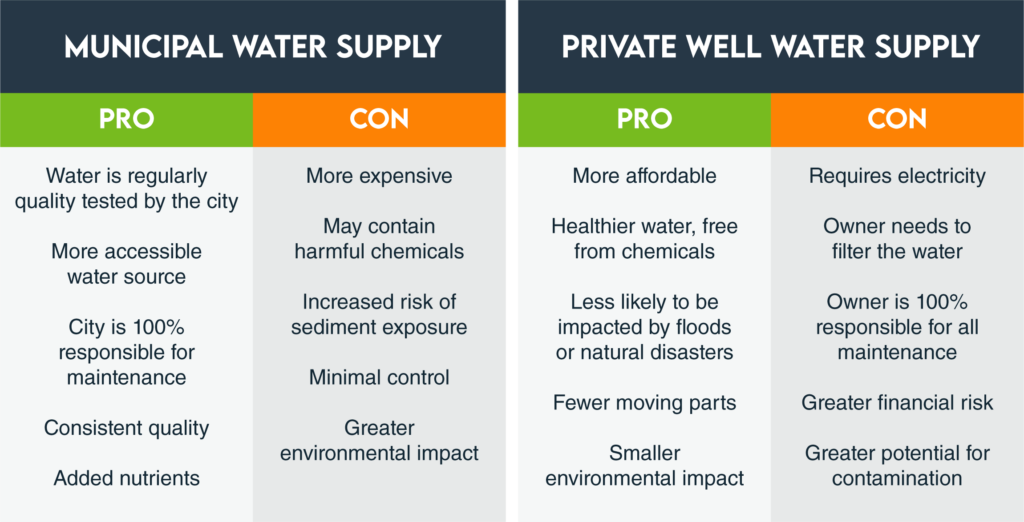
Sources: Angi.com and Culligan Water
Un-Smart Metering Standards
More than half of the nation’s site-built communities have installed, or have plans to install, automated read metering systems (aka ARMs or smart metering systems) to improve their utility management efforts. The manufactured housing industry, on the other hand, continues to prefer mechanical, manually read meters. As such, they are more likely to experience:
- Incorrect usage entries due to visually obstructed or hard-to-read equipment, increased data handoffs, or human error
- Prolonged leaks or usage increases
- Slower utility cost recovery
- Increased administrative stress
- Restricted access to meter-related data
Manufactured housing communities are also more likely to use master meters for resident bill-back instead of individual sub-meters—which also tends to increase the overall cost of utilities, as we will explain below.
Notice Any Trends?
If you were paying attention to the section above—which I hope you were—you probably noticed a couple of recurring issues or themes. First, manufactured housing units aren’t necessarily built-to-fail, but they are more prone to water damage and plumbing leaks. Second, manufactured home owners have options. And one of the options that we recommend is a two-pronged approach that includes both submeters and smart meters.
As mentioned above, the metering standard in the manufactured housing industry often involves manually-read master meters, or meters that only measure consumption at the property or community level. Because of this, most property owners (and their residents) are unaware of each unit’s actual utility usage—making it more difficult to identify abnormalities and encourage conservation.
Smart submetering systems, on the other hand, provide property teams with live updates for each unit. If there’s a leak or abnormality, property owners are alerted. If usage spikes, owners can drill down to find the problem unit. And, when residents receive their bills, and are held accountable for their actual usage, they are more motivated to make changes and conserve—often lowering their consumption by more than 30%.
Other benefits of smart submetered systems:
- Increased meter read accuracy
- Increased cost recovery
- More stabilized rent costs
- Decreased operating costs
- Minimized risk
- Increased property value
- Increased responsiveness to leaks and other costly dilemmas
- Increased transparency
- Increased conservation efforts (up to 30% reduction)
If Thorns Exist, Remove Them.
The great thing about thorns is that they can be removed… IF you have the right tools and the right team—and Conservice checks both of those boxes. Whether you are looking to install a state-of-the-art submetering system or simply want to make the most of the equipment you already have, our meter professionals can provide exactly what you need.
- Regulatory Support
- Support for all System Types
- Installations
- Expert Tech Support
- Accessible Data
- High Usage Alerts
Click here to learn more about our meter management solutions.



Subscribe To Our Blog Newsletter
Keep yourself ahead of the curve with the latest utility news, trends, & resources.
Editor's Picks

The State of Manufactured Housing in 2026
In 2024, we said manufactured housing was parking itself at the intersection of innovation and resilience. Two years later, the industry has A LOT more traffic to manage. Demand for manufactured housing is strong, although the latest numbers suggest operators…
Navigating Today’s Connectivity Landscape with Nic Arri
Navigating Today’s Connectivity Landscape with Nic | RSS.com The connectivity landscape is getting more complex, and multifamily owners and operators have some big decisions to make. We sat down with Nic Arri, Vice President of Solutions Consulting at Conservice, to…
Broadband & Beyond with Kevin Donnelly
Broadband & Beyond with Kevin Donnelly | RSS.com What’s next for broadband in multifamily? We sat down with Kevin Donnelly of the Real Estate Technology and Transformation Center (RETTC) to discuss the evolving landscape of multifamily connectivity. They explore the…
The Utility Partnership Playbook with Jeff Smedley & Scott Hines
The Utility Partnership Playbook with Jeff Smedley | RSS.com Who manages the utilities at a senior living community? Often, it’s a business manager or bookkeeper who is also juggling resident enrollment, retention, and day-to-day community operations. Lauren Howard sits down…
Utility Theft Detection: Protecting Revenue with Smart Monitoring
What does a case of “utility theft” even look like? A broken meter? A cyber attack? Someone hotwiring an electric panel like it’s some kind of car? Utility theft is a broad term for a simple concept—the loss of recoverable…

The Only 5 Utility Management Companies Worth Considering in 2026
The multifamily utility market has no shortage of providers. But only a handful offer the scale, service depth, technology, or specialization to deserve serious consideration in 2026. Five stand out: Conservice (unashamed plug, but true is true), RealPage, Yardi, Entrata,…

Why Should You Centralize Your Utility Management?
TL;DR Ever hear the saying “you need to get your ducks in a row”? That can be a difficult ask when those ducks are running in different directions, across multiple states. Some are even hiding from you, with a few…

Broadband Summit 2026 Debrief: The Infrastructure of Connectivity
Telecom strategy used to be limited to a few baseline questions: Who is the provider? What speeds do they offer? And are they offering the best rate? That was often the extent of the decision-making process. Walking out of Broadband…
Scaling Senior Living with Justin Brady
Scaling Senior Living with Justin Brady | RSS.com Who manages the utilities at a senior living community? Often, it’s a business manager or bookkeeper who is also juggling resident enrollment, retention, and day-to-day community operations. Lauren Howard sits down with…
Rental Junk Fee Laws in 2026: What Utility Billing Teams Need to Know
TL;DR: Fee transparency law is tightening in 2026, and most of the new rules target disclosure, not the formulas billing teams use to calculate a utility bill-back. This guide breaks down what counts as a junk fee, where disclosure rules…
Experience Effortless Utility Management and Cost Savings
Connect with us today to discover how our solutions can ease tenant billback, streamline utility management, and reduce your costs and energy usage. Make your utility management smarter and more efficient with Conservice!