
Though a waving red flag or a neon warning label would be nice, NOI erosion rarely announces itself. More often, it shows up quietly as routine utility charges that look almost right like an incorrect rate, a string of estimated reads, or a missed bill that never got questioned. While one invoice won’t move the needle, these small errors across an entire portfolio compound into one massive drain.
The challenge isn’t just the cost; it’s the visibility. When invoices aren’t verified, discrepancies blend into the background and make budgets harder to trust, reporting harder to validate, and recovery harder to pursue later.
But there is some good news: utility billing errors are preventable. And when you combine automation with expert oversight, they’re also recoverable.
Let’s break down where billing discrepancies come from, why they’re so difficult to spot, and how operators can protect NOI through verified, transparent utility expense management.
Where Billing Errors Originate: The Most Common Failure Points
Utility billing errors are rarely the result of one catastrophic issue. They tend to originate from small breakdowns in data, process, and oversight. And this makes sense; property teams have hundreds, if not thousands, of invoices to go through. So if something looks like a horse and sounds like a horse, it gets treated like a horse. Most of the time, that’s the right call. But every so often, it’s a zebra hiding in plain sight, and that’s where an expert eye makes the difference.
Here are the most common failure points our zebra-spotting Experts see.
1) Meter Misreads and Estimated Usage
Estimated reads are often introduced when there’s limited access to equipment, manual error, or meter malfunction. In some cases, estimates persist longer than expected, quietly distorting usage patterns and cost trends.
Even when the estimate is later corrected, timing matters. If the adjustment hits in a later billing cycle, it can create budget spikes that are difficult to explain and harder to defend.
2) Incorrect Rates or Tariff Updates
Rate structures change. Tariffs come and go. Provider rules shift.
But unless someone is actively monitoring those changes, invoices can reflect outdated rates for months. In larger portfolios, that lag adds up quickly, especially for high-consumption services like electricity and gas.
3) Data Handoff Gaps and Manual Entry Issues
Invoice processing often involves multiple systems and multiple hands. When charges are manually entered, transferred between platforms, or keyed in from PDFs, inconsistency creeps in:
- Duplicate invoices
- Missing bills
- Incorrect service dates
- Misapplied account numbers
It’s not a question of effort. It’s the reality of manual workflows at scale.
4) Submetering Gaps That Affect Resident Allocations
Submetering adds accuracy, but only when it’s working correctly. When meters aren’t calibrated, reads aren’t captured consistently, or data doesn’t reconcile cleanly, allocations can become misaligned.
That creates two outcomes property teams don’t want: owner-paid expenses increase or residents challenge charges more often. Both take time and money to mediate.
How Small Errors Compound Across a Portfolio
The reason utility discrepancies are so costly isn’t because each one is massive. It’s because they repeat.
A $5 variance on one property might not get noticed. But spread that across an entire portfolio, and the impact becomes a massive hit.
More importantly, billing inaccuracies introduce noise into your operating data. When the inputs aren’t trustworthy, performance analysis becomes harder:
- Year-over-year comparisons lose reliability
- Budgets and forecasts start to drift
- “Unusual” usage becomes difficult to validate
- Sustainability benchmarking becomes less accurate over time
That’s why utility bill management isn’t just an accounting function; it’s an asset performance issue.
The Audit-First Strategy: Automation + Expert Oversight
There’s a reason many operators are moving toward a hybrid approach that combines technology with expert review.
Automation can flag anomalies, but utility invoices often include details that still require context and verification. The strongest results come from using both.
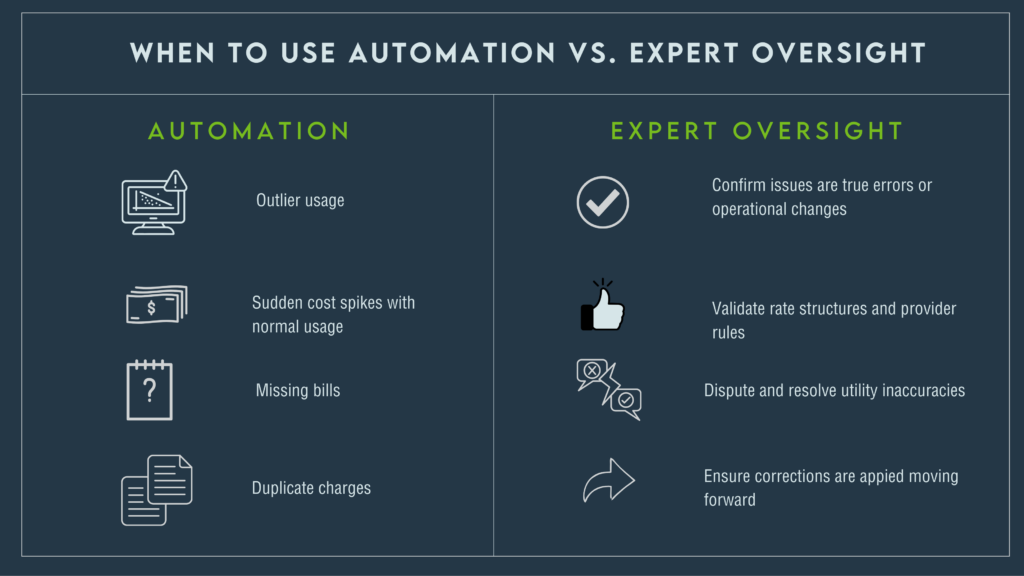
Automation spots the problem. Expertise fixes the problem.
Quick Wins That Recover NOI Faster
If you’re looking for immediate impact that you can accomplish in Q1, start with strategies that produce fast clarity and measurable recovery.
1) Audit high-cost properties first
Not all assets carry the same utility risk. Prioritize sites with:
- High total utility spend
- Frequent billing volatility
- Large common-area loads
- Repeated estimated reads
You’ll usually find the greatest recovery potential where spend is concentrated.
2) Re-review historical invoices for missed rate changes
Tariff drift is one of the most expensive “quiet failures” in utility billing. A back review can surface cases where a property was billed under the wrong rate structure longer than it should have been.
3) Repair or recalibrate submeters
When submeters are inaccurate, you lose twice: once in owner-paid expenses and again in resident friction. Recalibration restores billing integrity and supports cleaner allocation.
4) Enable alerts for estimated or missing bills
Two things should always prompt a closer look: estimated reads and gaps in billing cycles. Alerts help prevent issues from compounding quietly.
Sustaining Accuracy Long-Term (Without Adding Work to Your Team)
The goal isn’t just finding problems—it’s creating a process where billing stays accurate over time. That means building repeatable systems that scale with your portfolio.
Standardize invoice verification and escalation
Clear workflows reduce friction. When something does not align, teams should already know who reviews it, what qualifies as an anomaly, how it gets escalated, and how the resolution is documented. That consistency is what keeps one-off issues from turning into recurring costs.
Use portfolio analytics to spot trends early
Portfolio-level reporting helps patterns surface faster. It becomes easier to identify assets with chronic volatility, utility providers with repeated issues, persistent billing-cycle gaps, and outlier usage patterns before they become expensive surprises.
The earlier you catch trends, the less expensive they are to correct.
Improve the resident experience through transparency
While utility billing affects your bottom line, it can also affect something harder to build back: resident trust. Clear documentation and verified charges reduce disputes and build trust.
Transparency makes billing easier to support, easier to explain, and easier to stand behind.
TLDR: We can help
When operators want to protect NOI, they need more than data—they need verified results.
Expense Recovery helps identify billing discrepancies, pursue corrections, and recapture lost dollars tied to utility and invoicing errors.
Data & Analytics provides visibility into trends, anomalies, and portfolio-level performance so teams can act sooner, with confidence.



Subscribe To Our Blog Newsletter
Keep yourself ahead of the curve with the latest utility news, trends, & resources.
Editor's Picks
Navigating Today’s Connectivity Landscape with Nic Arri
Navigating Today’s Connectivity Landscape with Nic | RSS.com The connectivity landscape is getting more complex, and multifamily owners and operators have some big decisions to make. We sat down with Nic Arri, Vice President of Solutions Consulting at Conservice, to…
Broadband & Beyond with Kevin Donnelly
Broadband & Beyond with Kevin Donnelly | RSS.com What’s next for broadband in multifamily? We sat down with Kevin Donnelly of the Real Estate Technology and Transformation Center (RETTC) to discuss the evolving landscape of multifamily connectivity. They explore the…
The Utility Partnership Playbook with Jeff Smedley & Scott Hines
The Utility Partnership Playbook with Jeff Smedley | RSS.com Who manages the utilities at a senior living community? Often, it’s a business manager or bookkeeper who is also juggling resident enrollment, retention, and day-to-day community operations. Lauren Howard sits down…

Utility Theft Detection: Protecting Revenue with Smart Monitoring
What does a case of “utility theft” even look like? A broken meter? A cyber attack? Someone hotwiring an electric panel like it’s some kind of car? Utility theft is a broad term for a simple concept—the loss of recoverable…

The Only 5 Utility Management Companies Worth Considering in 2026
The multifamily utility market has no shortage of providers. But only a handful offer the scale, service depth, technology, or specialization to deserve serious consideration in 2026. Five stand out: Conservice (unashamed plug, but true is true), RealPage, Yardi, Entrata,…

Why Should You Centralize Your Utility Management?
TL;DR Ever hear the saying “you need to get your ducks in a row”? That can be a difficult ask when those ducks are running in different directions, across multiple states. Some are even hiding from you, with a few…

Broadband Summit 2026 Debrief: The Infrastructure of Connectivity
Telecom strategy used to be limited to a few baseline questions: Who is the provider? What speeds do they offer? And are they offering the best rate? That was often the extent of the decision-making process. Walking out of Broadband…
Scaling Senior Living with Justin Brady
Scaling Senior Living with Justin Brady | RSS.com Who manages the utilities at a senior living community? Often, it’s a business manager or bookkeeper who is also juggling resident enrollment, retention, and day-to-day community operations. Lauren Howard sits down with…

Rental Junk Fee Laws in 2026: What Utility Billing Teams Need to Know
TL;DR: Fee transparency law is tightening in 2026, and most of the new rules target disclosure, not the formulas billing teams use to calculate a utility bill-back. This guide breaks down what counts as a junk fee, where disclosure rules…

Conservice’s 2nd Annual 5K Brings Together More Than 500 Participants and Gives Back to Cache Valley
LOGAN, Utah — September 10, 2026 — Conservice celebrated its second annual 5K Fun Run on September 9, bringing employees, families, and community partners together for an afternoon of connection and giving back. More than 550 people registered for this…
Experience Effortless Utility Management and Cost Savings
Connect with us today to discover how our solutions can ease tenant billback, streamline utility management, and reduce your costs and energy usage. Make your utility management smarter and more efficient with Conservice!