
The wait is over—well, almost! The EPA has officially announced the launch of ENERGY STAR NextGen certification, a new tier designed to recognize the nation’s most energy-efficient, low-emissions buildings. Applications open on February 24, 2025, giving properties just a few months to prepare for the program.
Unlike the standard ENERGY STAR certification, NextGen goes further by addressing direct emissions and renewable energy use. If your property is already ENERGY STAR-certified, you’re well on your way, but meeting NextGen’s enhanced standards will require strategic action and meticulous preparation. Here’s what you need to know:
ENERGY STAR vs. NextGen: A New Standard
At first glance, NextGen looks like ENERGY STAR with some added features. But a closer look reveals something more: a rigorous, forward-thinking standard crafted to help buildings meet the demands of a low-carbon future. Here’s how the two stack up:
- Eligibility and Performance Requirements
- ENERGY STAR: Requires a performance score of 75 or higher.
- NextGen: In addition to a score of 75, properties must meet enhanced standards in renewable energy use and emissions reduction.
- Renewable Energy Use
- ENERGY STAR: Focuses primarily on overall energy performance.
- NextGen: Requires properties to obtain at least 30% of their energy from renewable sources, or 100% of electricity if that’s the lesser amount.
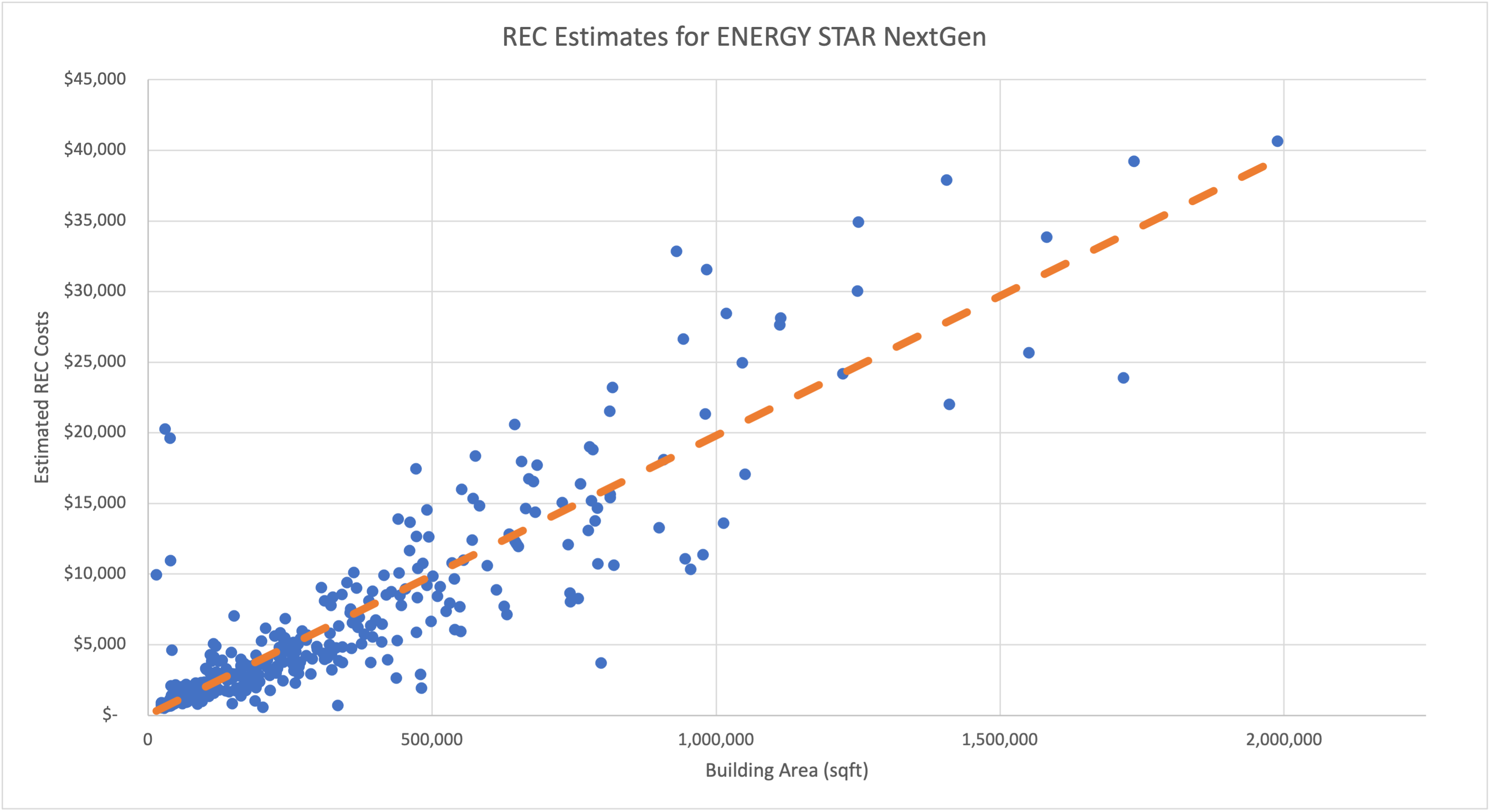
A significant component of the ENERGY STAR NextGen certification is the use of renewable energy. Buildings must meet strict renewable energy targets, often through Green-e certified Renewable Energy Credits (RECs). Below is a graph showing REC Estimates for ENERGY STAR NextGen. Energy consumption correlates with building size, and this chart offers a ballpark estimate of REC costs based on $5 per REC. The dotted trendline provides a general guideline, but obtaining a precise quote is critical.
To meet these requirements, Conservice ESG can help benchmark your facility, calculate the renewable energy needed, and secure a quote through our in-house energy procurement department, ensuring a seamless certification process.
- Direct Emissions Targets
- ENERGY STAR: The goal is relative energy efficiency, assessing a building’s performance relative to similar buildings but does not directly address on-site emissions or carbon intensity.
- NextGen: A specific target for direct, on-site greenhouse gas emissions (GHGi). Each building type has its own emissions intensity target, making NextGen especially relevant for properties aiming to reduce their direct carbon footprint on-site.
- Certification Frequency
- Properties can apply for both certifications in the same year, but only until December 2025. After that, applications must be spaced at least 11 months apart. Don’t wait—applications for NextGen certification are open now in the EPA’s Portfolio Manager. View the full criteria here.
By setting a higher bar for renewable energy use and direct emissions, NextGen is designed to encourage buildings to take meaningful steps toward sustainability.
Why Get Ready Now?
The benefits of earning NextGen certification extend far beyond recognition. This designation:
- Demonstrates leadership in sustainability and ESG initiatives.
- Positions your property to comply with future regulations on emissions and energy use.
- Reduces long-term energy costs and carbon footprint.
By preparing now, you’ll be ready to submit your application when the EPA opens the window in February 2025.
How Conservice Can Help Prepare Your Buildings
Let’s be real—navigating new certification standards is rarely straightforward. NextGen requires careful tracking and validation. We support clients every step of the way—from verifying compliance with NextGen’s renewable energy, emissions, and performance criteria to tracking essential data points like ENERGY STAR scores and greenhouse gas emissions. Our team provides the expertise needed to streamline the application process, ensuring properties are fully prepared to meet NextGen’s requirements and maintain certification. With Conservice as your partner, reaching this advanced level of sustainability becomes simpler and more achievable.
Why Pursue NextGen Certification?
Earning NextGen certification places your property among the most energy-efficient and low-carbon buildings in the U.S. The designation demonstrates your commitment to sustainability and can be a key advantage for properties with strong ESG goals. By aligning with the most forward-looking standards, NextGen-certified buildings are better positioned to meet current and future regulations on energy performance and emissions, providing long-term value in energy management and cost savings.
By preparing now, you’ll be ready to submit your application when the EPA opens the window in February 2025.
Now What?
Don’t wait to start your NextGen journey. Conservice is here to help you get your buildings ready. From verifying your data to guiding you through the application process, we’ll ensure your properties meet these advanced standards.
Applications open February 24, 2025. Ready to lead the way in sustainability? Learn more about NextGen certification here.



Subscribe To Our Blog Newsletter
Keep yourself ahead of the curve with the latest utility news, trends, & resources.
Editor's Picks

Good Data In, Good Data Out: The Key To Turn Season
It’s that time of year again for student housing. Move-outs are piling up nearly as fast as move-ins and student housing operators and property teams have just a few short weeks to get it all sorted before the next wave…

Improving Resident Experience Through Connectivity: 4 Reasons Bulk Internet Actually Works
Multifamily owners and operators are rethinking how connectivity is delivered. Bulk internet programs are becoming an increasingly valuable solution.

Conflict in Iran Affects Utility Costs
The situation in Iran is already having measurable economic effects. While much of the attention has focused on geopolitical implications, the financial impact on consumers is becoming increasingly clear. At the time of this publication, U.S. consumers have absorbed an…

A Practical Way to Prioritize Climate Risk Across Your Portfolio [Rent at Risk: Part 3]
Climate risk analysis produces a long list of exposures across assets and markets, but it does not always produce a clear path forward. How should you leverage and prioritize available data?

Utility University: March 2026
Utility costs are rising but this isn’t just another temporary spike. From increasing energy demand to the growing role of internet as essential infrastructure, the utility landscape is evolving fast. Here’s what property teams need to know to stay ahead.

The ROAD to Housing Act: What It Means for Supply, Renters, and Operators
The Senate passed the ROAD to Housing Act on March 12 with an 89-10 vote. That kind of margin is rare, especially for something as complex as housing policy. On paper, that kind of support should signal momentum. In reality, it highlights something more interesting.

What 650 Property Audits Revealed About Utility Rate Misalignment
Most utility bills are treated as a given. They arrive, they’re processed, and they’re paid. In some cases, they’re allocated or passed through to residents, but structurally, they are rarely questioned. Utilities tend to sit in the category of “fixed”…

The 8 Climate Hazards Multifamily Investors Should Be Screening For [Rent at Risk: Part 2]
Some hazards create gradual operational pressure. Others introduce the potential for sudden, high-impact loss events. Some are widespread across nearly every region. Others are highly concentrated geographically but carry larger financial consequences when they occur. Understanding those differences is critical when screening portfolios. Because not all climate hazards carry the same implications for multifamily performance.

Vacant Cost Recovery (VCR): The Complete 2026 Guide
Utility billing doesn’t always line up cleanly with move-ins and move-outs. When it doesn’t, properties often end up covering costs that belong to residents. This article walks through how Vacant Cost Recovery helps catch those gaps and recover what would otherwise be lost.

New Rules. Same Old Trash. Ask an Expert with Tedd Schonsheck
Meet Tedd Schonsheck: Waste strategist. Former Army officer. Recovering retail executive. Now, he’s one of the people dedicated to making sure trash actually works for property owners and managers.
Experience Effortless Utility Management and Cost Savings
Connect with us today to discover how our solutions can ease tenant billback, streamline utility management, and reduce your costs and energy usage. Make your utility management smarter and more efficient with Conservice!