
Why Doing Everything Right Still Costs More
First the lightning. Then the thunderclap. Right?
The lightning. Over the last 18 months, AI, in all of its many and emerging forms, roared across the U.S. And while cultural and enterprise hesitance around its uses abound, infrastructural appetite to facilitate its growth has exploded.
The thunder. According to a Connected Grid Initiative report from late 2025, Data centers now account for roughly 55% of all projected U.S. electricity demand growth over the next five years. That single projection explains almost everything about utility YoY utility trends that are breaking, bending, or getting more expensive. Electricity, gas, water, and sewer costs are no longer driven by simple consumption or fuel prices; they’re being reshaped by industrial-scale load growth, massive resilience investments in the built environment, tighter regulations on the state-side, and a general (especially on the investment front) demand for transparency.
AI Isn’t the Whole Story
AI isn’t solely to blame though. It’s no secret that electricity costs across the nation, to some extent or another, rose throughout 2025. The EIA (U.S. Energy Information Agency) has flagged continued upward pressure on retail electricity prices as a major factor for last year’s hikes and this year’s projected cost increases. The key pressures? Rising commercial demand (including golden oldies like crypto and data centers) and an uptick in grid upgrades.
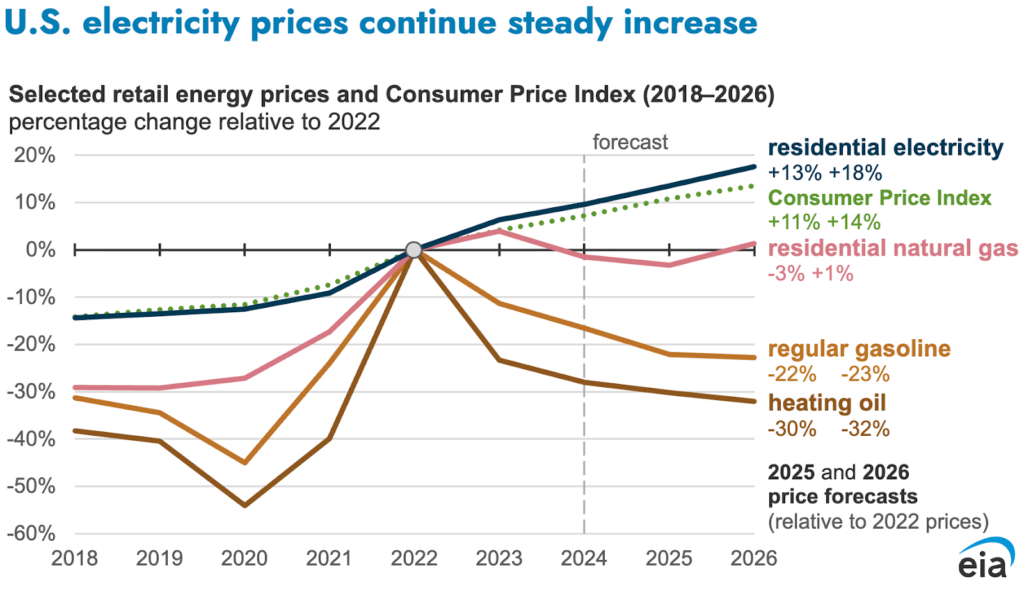
KEY PREDICTIONS AND TRENDS: Expect higher rate pressure and more complex rate structures as utilities plan for new peaks and heavier baseload.
The Grid Is Under Stress. Our Industry Is Along for the Ride.
What matters for our industry isn’t just that demand is growing. It’s how utilities respond to that growth. As a highly regulated and macro-economic force, utility providers don’t wait for demand to materialize before acting. They revise load forecasts upward, model new peaks, and plan for heavier baseload demand. Those forecasts feed directly into capital plans, infrastructure investment, and (most importantly) rate design.
KEY PREDICTIONS AND TRENDS: Even if your property uses less electricity per unit than it did 5 years ago, your rates may still rise because of the demand encircling you.
In May 2024, FERC issued Order No. 1920, a landmark reform requiring long-term, scenario-based regional transmission planning and new, standardized cost-allocation methods for long-term regional transmission facilities. It directs transmission providers to plan 20 years ahead using multiple future scenarios to identify, evaluate, and select cost-effective transmission solutions, and to develop an ex ante default cost allocation methodology with state engagement (though it does not mandate specific construction).
This matters because transmission planning has historically been more reactive and shorter-term. Order 1920 explicitly—and proactively—shifts planning into a long-term horizon and scenario framework. That shift influences utility rate cases, capital recovery assumptions, and cost distribution well before new lines or substations are built, because compliance filings and tariff changes reflecting planning and cost allocation frameworks occur upstream in the regulatory process.
That’s where the idea that “doing nothing is neutral” breaks down: accelerated transmission planning means earlier cost allocation and rate implications, so waiting or reducing load is not a neutral strategic stance. Transmission planning affects property owners and operators long before they see physical infrastructure. The bill moves first; the infrastructure follows.
Resilience Investments Are Not One-Offs, They’re Permanent Line Items
Reliability isn’t something you pay for only when it fails. You pay for it continuously, through rates. For decades, grid reliability was treated like insurance: expensive when it failed, invisible when it worked. Now, utilities across the country are investing heavily in resilience—hardening systems against extreme weather, wildfire, flooding, and prolonged heat or cold. According to EIA data (you can find their deep dive, visualized data here), rising electric utility capital investment in recent years has been driven largely by grid infrastructure upgrades, resilience projects, and modernization, alongside new generation and smart grid technologies.
Consider the way reliability risk is now assessed. NERC’s 2025–2026 Winter Reliability Assessment identifies ongoing regional vulnerabilities driven by rising demand and weather stress — especially in grids not built for sustained winter peaks. When extreme conditions become part of the planning baseline, resilience stops being a reaction to failure and becomes a permanent feature of the cost structure.
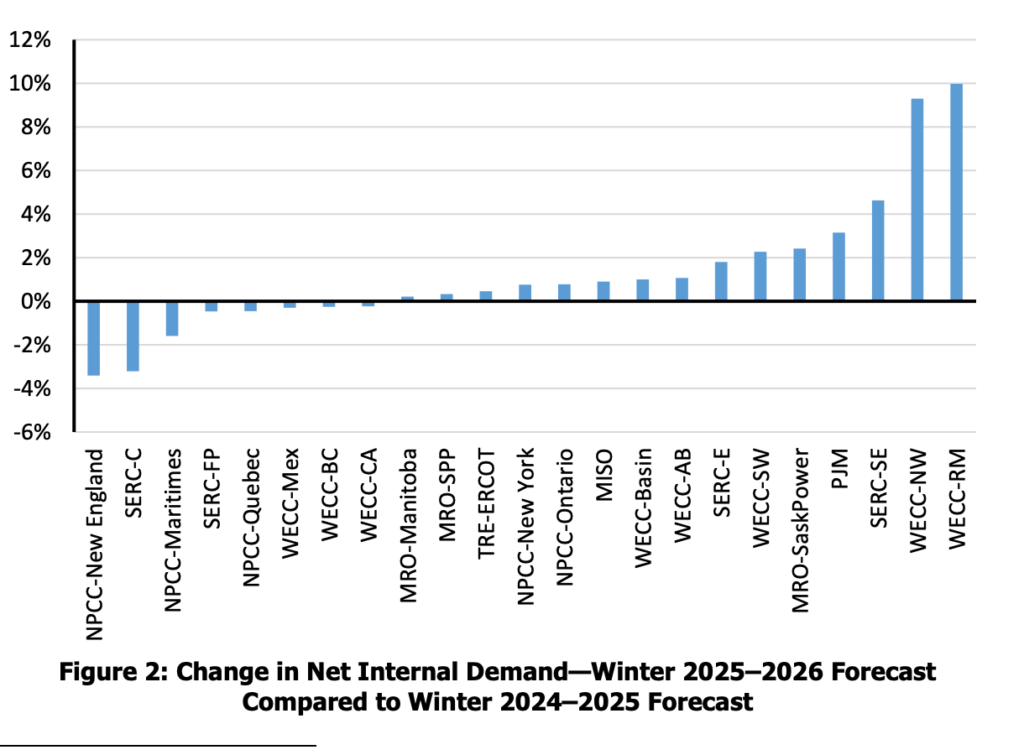
Graph created by NERC.
“Winter electricity demand is rising at the fastest rate in recent years, particularly in areas where data center development is occurring.”—North American Electric Reliability Corporation
Speaking to the regulatory environment and the long term, proactive cost hikes in utilities, and extreme weather events are no longer treated as edge cases. They are assumptions.
The Advantage Has Shifted: From Cheaper Utilities to Better Systems
By now, a pattern should be clear. Electricity costs are rising because the grid is under structural stress. Transmission costs move before infrastructure appears, and resilience spending is baked in, not episodic.
The best way to mitigate these headwinds is with centralized, reliable management systems:
- Better forecasting that anticipates volatility instead of reacting to it
- Disciplined bill audit and exception handling when rates and structures change
- Clear allocation logic that residents can understand and trust
- Faster detection of anomalies before they become recurring costs
- Resident support that treats utilities as part of the experience, not an afterthought
In this environment, the owners, operators, and property professionals who win will be the ones building systems to manage volatility, navigate regulatory complexity, and leverage utilities and ancillary sources of revenue to drive up the cap rates of their properties.
Conservice is that partner for end-to-end utility management. Learn more here.



Subscribe To Our Blog Newsletter
Keep yourself ahead of the curve with the latest utility news, trends, & resources.
Editor's Picks

The How-to Guide for Reducing CAM Charges and Shared Space Costs
TL;DR When investigating where to reduce CAM charges and multifamily common-area costs, shared utility expenses might be the place to start. A higher bill doesn’t automatically signal waste, so it’s important to compare cost and consumption before deciding where to…

Installing EV Charging Stations: A Guide for Multifamily Property Owners
Have there always been this many electric vehicles on the road? It looks like the silent hum of an EV has become a roar, as Electric vehicles take the United States by storm. With the rise of EVs, comes the…
Policy Watch: Compliance & Building Readiness with Brett Kraus and Michelle Winters
Policy Watch: Compliance & Building Readiness with | RSS.com In this episode of Utility Wisdom, Michelle Winters, Vice President of Sustainability Sales at Conservice, sits down with Brett Kraus, Senior Legal Counsel, and Katie Piel, Sustainability Manager, to break down…
Conservice Earns 15th Appearance on Inc. 5000
RIVER HEIGHTS, Utah, August 14, 2026 – Conservice, the nation’s leading utility management provider, has been named to the 2026 Inc. 5000, marking the company’s 15th appearance on the annual list of America’s fastest-growing private companies. The recognition adds another…

5 Signs Your Telecom Strategy Needs An Update
Telecom has a funny way of becoming someone’s problem. A resident can’t get connected, so they call the onsite property team. A provider needs an answer, so someone digs through an old agreement. A renewal date appears on the calendar,…

How to Streamline Invoice Processing & Auditing
Utility bills have a lot to say. They can tell you where costs are climbing and where usage looks unusual. They can point to a provider error before it hits your bottom line. And across hundreds or thousands of accounts,…

Ask An Expert with Sustainability Expert, Sandra Closson
Meet Sandra Closson Some people see spreadsheets full of utility data. Sandra sees a story about how a building operates and where it can improve. With nearly three decades of professional experience and 17 years in sustainability, Sandra has built…

The Next Chapter of Single Family Operations
At some point “more” stops being the answer. The single family industry has spent the last decade defining success as growth. Build new properties, acquire existing properties, attract institutional investment, repeat. Portfolios grew from hundreds of homes to thousands. “More”…

RUBS Utility Billing vs. Submetering: A Decision Guide
RUBS Utility Billing vs. Submetering A Decision Gu | RSS.com TL;DR: Not every property gets to choose between RUBS and submetering – your building, budget, and state regulations all play a role. RUBS (Ratio Utility Billing System) is faster and…

NAA 2026 Debrief: AI Everywhere, Automation Under Pressure, and the Human Work of Multifamily
NAA 2026 Debrief: AI Everywhere, Automation Under | RSS.com Attending this year’s Apartmentalize (which was truly excellent, by the way), you couldn’t help but notice a contrast. On the one hand, the vendor floor was an absolute sea of AI…
Experience Effortless Utility Management and Cost Savings
Connect with us today to discover how our solutions can ease tenant billback, streamline utility management, and reduce your costs and energy usage. Make your utility management smarter and more efficient with Conservice!