
You hear “greenhouse gas emissions” and you think…what? “Cars,” certainly. “Industry,” probably. “Agriculture” generally, and “cows” tragically.
It might surprise you, then, to find out that a major portion of our nation’s contributions to global greenhouse gas emissions come from the operation of regular old commercial and residential structures. In fact, buildings account for a whopping 35% of the total energy-related emissions in the United States—and the municipalities who govern our industry have taken notice.
All over the country, many cities and a rising number of states have begun implementing building performance standards (BPS), a type of regulation specifically designed to regulate and reduce carbon and energy consumption in existing buildings by forcing them to achieve set sustainability goals by specific dates.
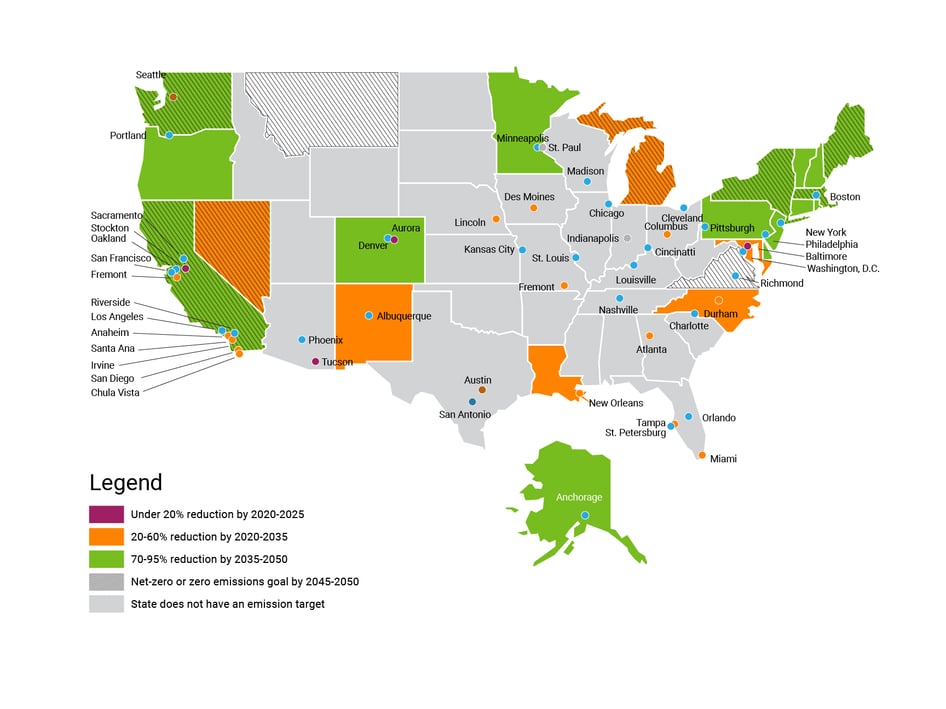
If you’re not especially familiar with BPS, don’t feel bad. They’re a relatively new regulatory tool. Various forms of ESG regulations have long been the norm in many commercial industries, but BPS as a specific outcome-based approach has only really started to proliferate over the last few years (except in New York, they’ve been around for a long time there).
So What Exactly IS a BPS?
Across the nation, building performance standards are enacted with a huge variety of ordinances and a wide range of timelines. Generally, however, a BPS is an outcome-based policy or law designed to reduce the carbon impact of a built environment by requiring existing buildings to meet energy or GHG emissions-based performance targets. And while the vast majority of these regulations are established at the city level, an increasing number of states have also begun to join the party. All in all, as of the creation of this article, over 600 local U.S. jurisdictions have adopted greenhouse gas reduction goals.

In a way, you can think of BPS as the highest order of sustainability standards a government body might throw at you. Generally, compliance reporting for commercial structures falls into one of three distinct categories of requirements:
BENCHMARKING: Think of it as pass or fail homework. It doesn’t really matter how you did, just whether you turned it in on time. Benchmarking ordinances typically require businesses to report building energy data to the government. And as critical as it is for organizations to meet their sustainability goals, the key to benchmarking regulations is actually submitting the report. Benchmarking building performance standards will usually inflict penalties and fines for failing to report on energy usage—regardless of a given structure’s performance.
ENHANCED BENCHMARKING: Now the homework’s harder. Not only do you have to turn it on time, but depending on your answers, your teacher might make you redo your work. Enhanced benchmarking includes the report submission requirements of regular benchmarking, but may also require businesses to take additional actions to meet sustainability goals. Depending on your building’s energy score, you may be mandated to perform additional energy audits or outright structural retrofits.
BUILDING PERFORMANCE STANDARDS: And finally, the actual test. Turn your work and get the answers right, or you’ll pay out of your own pocket. Under the thumb of BPS, reporting to the government is mandatory, and your buildings must meet specific metrics. Non-compliance will generally result in outright fines.
Watch our in-depth webcast, Building Performance Standards 101
As nice as a clear distinction between the three compliance reporting types would be, there often isn’t one. Consider BERDO 2.0, a Boston City reporting and ordinance disclosure. Initially, it requires buildings over 20,000 GSF to annually report on emissions by May 15th of each year, making it a relatively straight forward benchmarking requirement. But come 2025, the ordinance will grow to also require buildings to meet a series of very particular emission standards, at which point it will be a full fledged building performance standard.
Typically, BPS laws will consider property type, size, and potential exemptions. And there’s not really a one-type-fits all pathway to compliance. Sometimes they’ll include measuring performance against baseline data, while other times they’ll include black and white targets, and many of them involve third-party validation to achieve submission compliance. Also…they’re not static. In the few years we’ve had to track their emergence and evolution across the nation, they not only tend to change over time—they tend to become more stringent. So, once you begin the process of achieving a given BPS for your structures, you’ll need to remain vigilant that your properties remain compliant over time.
Another day, Another Suite of Regulatory Obstacles
However you feel about the macro impact that property regulations have on society and the ecosystem, they’re a headache for the businesses trying to meet them. While the difficulty of complying with a given BPS very much depends on which city you live in, they tend to share a suite of challenges you should consider when building your sustainability strategy:
- Uniqueness: Each BPS law has distinct criteria, compliance pathways, deadlines, and penalties. They’re hard to navigate without expert guidance, and mistakes can be expensive.
- Nuanced: Subtleties and changes in laws make compliance difficult, especially when laws differ between climate zones or require intricate calculations.
- Sophisticated metrics: Some BPS laws require fairly straightforward metrics like ENERGY STAR scores, while others involve extremely complex calculations such as CO2 equivalent or reduction targets. Again, expert assistance is advised.
- Weather dependency: It’s not just your picnics and baseball games watching out for rain anymore—building performance can very much be influenced by weather conditions, which can lead to variations in compliance over time.
The Fines are Steep, But the Leniency is Real
The following observation regarding BPS is absolutely not legal advice. But it is anecdotally defensible.
 While we recommend you do absolutely everything you can to comply with any building performance standards affecting your properties, we would also want you to know that from everything we’ve heard, read, and seen, honestly trying goes a long way for the powers that be.
An Honestly Solid Solution? Let Someone Else Handle It
Like taxes, car repairs, and estate planning, there is absolutely no shame in letting an organization that specializes in navigating the nuances of a complicated field shoulder most of the burden. If a BPS is or might soon be putting pressure on your organization to submit complicated reports or enact expensive retrofits, consider involving the services of a professional property sustainability service like Conservice S2. It automatically tracks usage data and can collate your properties utility information into whatever report format your BPS requires, and the sustainability professionals who facilitate it can audit your properties, research your BPS, and make practical recommendations regarding the retrofits you should consider.



Subscribe To Our Blog Newsletter
Keep yourself ahead of the curve with the latest utility news, trends, & resources.
Editor's Picks

Utility Theft Detection: Protecting Revenue with Smart Monitoring
What does a case of “utility theft” even look like? A broken meter? A cyber attack? Someone hotwiring an electric panel like it’s some kind of car? Utility theft is a broad term for a simple concept—the loss of recoverable…

The Only 5 Utility Management Companies Worth Considering in 2026
The multifamily utility market has no shortage of providers. But only a handful offer the scale, service depth, technology, or specialization to deserve serious consideration in 2026. Five stand out: Conservice (unashamed plug, but true is true), RealPage, Yardi, Entrata,…

Why Should You Centralize Your Utility Management?
TL;DR Ever hear the saying “you need to get your ducks in a row”? That can be a difficult ask when those ducks are running in different directions, across multiple states. Some are even hiding from you, with a few…

Broadband Summit 2026 Debrief: The Infrastructure of Connectivity
Telecom strategy used to be limited to a few baseline questions: Who is the provider? What speeds do they offer? And are they offering the best rate? That was often the extent of the decision-making process. Walking out of Broadband…

Scaling Senior Living with Justin Brady
Scaling Senior Living with Justin Brady | RSS.com Who manages the utilities at a senior living community? Often, it’s a business manager or bookkeeper who is also juggling resident enrollment, retention, and day-to-day community operations. Lauren Howard sits down with…

Rental Junk Fee Laws in 2026: What Utility Billing Teams Need to Know
TL;DR: Fee transparency law is tightening in 2026, and most of the new rules target disclosure, not the formulas billing teams use to calculate a utility bill-back. This guide breaks down what counts as a junk fee, where disclosure rules…

Conservice’s 2nd Annual 5K Brings Together More Than 500 Participants and Gives Back to Cache Valley
LOGAN, Utah — September 10, 2026 — Conservice celebrated its second annual 5K Fun Run on September 9, bringing employees, families, and community partners together for an afternoon of connection and giving back. More than 550 people registered for this…

The How-to Guide for Reducing CAM Charges and Shared Space Costs
TL;DR When investigating where to reduce CAM charges and multifamily common-area costs, shared utility expenses might be the place to start. A higher bill doesn’t automatically signal waste, so it’s important to compare cost and consumption before deciding where to…

Installing EV Charging Stations: A Guide for Multifamily Property Owners
Have there always been this many electric vehicles on the road? It looks like the silent hum of an EV has become a roar, as Electric vehicles take the United States by storm. With the rise of EVs, comes the…
Policy Watch: Compliance & Building Readiness with Brett Kraus and Michelle Winters
Policy Watch: Compliance & Building Readiness with | RSS.com In this episode of Utility Wisdom, Michelle Winters, Vice President of Sustainability Sales at Conservice, sits down with Brett Kraus, Senior Legal Counsel, and Katie Piel, Sustainability Manager, to break down…
Experience Effortless Utility Management and Cost Savings
Connect with us today to discover how our solutions can ease tenant billback, streamline utility management, and reduce your costs and energy usage. Make your utility management smarter and more efficient with Conservice!