






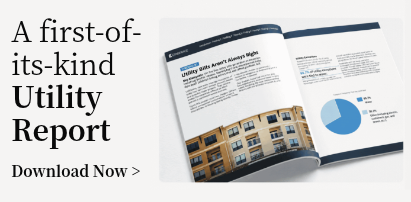







Most utility bills are treated as a given.
They arrive, they’re processed, and they’re paid. In some cases, they’re allocated or passed through to residents, but structurally, they are rarely questioned. Utilities tend to sit in the category of “fixed” operating costs. They’re appreciated as important, but not considered strategically fundamental.
Which is understandable. Utilities are essential, recurring, and largely outside of an operator’s direct control. They also represent a meaningful portion of overall expenses. In multifamily properties, utilities typically account for between 15% and 20% of total operating costs. For most portfolios, that places them among the largest expense categories, often trailing only taxes, insurance, and payroll.
But despite their scale, the underlying structure behind utility costs is rarely interrogated.
Over the past year, we conducted a detailed audit of utility rate structures across more than 650 multifamily properties that had recently come under management. Our objective wasn’t to uncover savings, at least not in the traditional sense. It was to answer a more fundamental question: are these properties actually on the correct utility rates?
The answer, in a surprising number of cases, was no.
Calculations can be right. The rate can be off.
Across those 650 properties, our audit identified 148 individual meter accounts operating on incorrect or suboptimal rate structures. These were spread across 136 separate properties and represented $1,851,814.97 in projected annual savings. Importantly, these were not billing errors in the conventional sense. The utilities themselves were not miscalculating charges. The issue was structural.
In many cases, properties had simply been placed on a rate that no longer reflected how they operate.
- That might include being classified under a general commercial rate rather than a multifamily-specific one,
- Or remaining on a legacy rate tier that no longer aligns with actual usage patterns.
In other instances, changes to the property—renovations, occupancy shifts, or ownership transitions—had occurred without a corresponding reassessment of the rate structure.
None of these scenarios is unusual in isolation. But at scale, they create measurable impact.
Accuracy is not Always Intuitive.
Utility rate structures are highly localized, frequently updated, and dependent on a mix of infrastructure, usage behavior, and classification decisions. They are applied differently across providers and jurisdictions, and they rarely come with any kind of automatic validation mechanism. At the same time, operating conditions at the property level are constantly evolving. Occupancy fluctuates. Systems are upgraded. Consumption patterns shift over time.
What does not tend to change (at least not without intervention) is the rate itself.
That static quality becomes more significant in the current operating environment. Since 2021, multifamily operating expenses have increased across the board, with utilities alone rising by more than 10% in many major U.S. markets. As cost pressure increases, even relatively small inefficiencies become more consequential. A one to two percent shift in operating expenses can have a meaningful impact on net operating income, particularly in tighter margin environments.
Which raises an uncomfortable but necessary question: how much of utility cost is truly inherent, and how much is simply unexamined?
Searching for Savings: Consumption vs Rate Structure
Most conversations around utility optimization focus on consumption. Reducing water usage, improving energy efficiency, and upgrading infrastructure are all valuable strategies, and in many cases, essential ones. But they operate on a single dimension of the problem: how much is used.
Our audit points to another dimension entirely: how that usage is being priced.
THE MAIN IDEA: Before any efficiency measures take effect, the rate structure defines the baseline cost. If that structure is misaligned, every downstream improvement is built on an imperfect foundation. Unlike consumption reductions, which often require capital investment, rate alignment is primarily a function of visibility and analysis. It is less about changing behavior and more about understanding the framework already in place.
With a sample size of more than 650 properties, these findings are difficult to dismiss as outliers. They suggest a broader pattern, one shaped by inherited assumptions, rarely revisited classifications, and systems that continue operating long after underlying conditions have changed.
And for the record, we’re not arguing that improper rate structures are the result of negligence. In our experience, they’re a byproduct of complexity.
Utility billing spans multiple providers, regulatory environments, and rate schedules. Even well-managed portfolios can accumulate small misalignments over time simply because the system itself is fragmented. And in most cases, there is no built-in mechanism forcing a review.
Which means that, left alone, the system does what most complex systems do: it persists.
There is a tendency in the industry to treat utilities as a fixed input…something to process efficiently rather than question structurally. That mindset may have been sufficient in a more stable cost environment. It is less effective when expenses are rising and margins are under pressure.
What this audit ultimately highlights is a shift in perspective. Utility costs are not solely a function of consumption. They are also a function of classification, interpretation, and timing. And those elements, unlike the underlying commodity, are not fixed.
The implication is straightforward. Before assuming utility costs are fully understood, it may be worth asking a simpler question: are they even configured correctly?
And if you’d like a hand in auditing the rate structures across your portfolio, connect with us. Anything and everything utilities is what we do.



Subscribe To Our Blog Newsletter
Keep yourself ahead of the curve with the latest utility news, trends, & resources.
Editor's Picks

Budgeting for Apartment Utilities in 2027: Costs, Benchmarks, and Billing
Plan your 2027 multifamily utility budget with cost benchmarks, regional insights, and billing considerations for owners and operators.
What is Water Submetering? Here’s Your Guide.
Reading a community’s water bill is like trying to make an accusation halfway through a game of Clue. You have limited cards in your hand. You might know it was Professor Plum who was killed, but was it with the…

Affordable Housing Utility Programs: HUD Allowances and LIHTC Compliance
A resident budgets for rent each month, but the electric bill leaves a little less room for groceries than it did last year. At the property office, your team is reviewing the utility allowance that accounts for those costs in…

Ask An Expert: With Sustainability Expert Jason Krychiw
Meet Jason Krychiw Jason Krychiw started his career in the research camp. Yet somewhere between studying biofuels and environmental impacts, he found himself drawn to work with a more direct human impact. That need for purposeful work led him to…

Don’t Mistake AI for Automation: A Primer for Property Management
At October’s Rent Manager User Conference, a speaker asked a room of property management professionals a simple question: “How many of you track the late fees you’re paying on utility bills?” In a room packed with dozens and dozens of…

More Doors = More Moving Parts: Growing Utility Management with Your Portfolio
More Doors = More Moving Parts: Growing Utility Management with Your Portfolio It’s alive! The multifamily market is alive! The industry’s biggest property managers have developed a serious appetite for growth. This year’s rankings show just how many doors they’ve added.…

The State of Manufactured Housing in 2026
The State of Manufactured Housing in 2026 | RSS.com In 2024, we said manufactured housing was parking itself at the intersection of innovation and resilience. Two years later, the industry has A LOT more traffic to manage. Demand for manufactured…

Utility Theft Detection: Protecting Revenue with Smart Monitoring
What does a case of “utility theft” even look like? A broken meter? A cyber attack? Someone hotwiring an electric panel like it’s some kind of car? Utility theft is a broad term for a simple concept—the loss of recoverable revenue to undetected utility use. This can include physical meter tampering, missed service transfers, account…

The Only 5 Utility Management Companies Worth Considering in 2026
The multifamily utility market has no shortage of providers. But only a handful offer the scale, service depth, technology, or specialization to deserve serious consideration in 2026. Five stand out: Conservice (unashamed plug, but true is true), RealPage, Yardi, Entrata, and Zego. Each brings a different strength to the table. Some embed utilities directly into…

Why Should You Centralize Your Utility Management?
TL;DR Ever hear the saying “you need to get your ducks in a row”? That can be a difficult ask when those ducks are running in different directions, across multiple states. Some are even hiding from you, with a few practically kidnapped by strangers, turning duck management into a wild goose chase. Unfortunately, we’re handling…
Experience Effortless Utility Management and Cost Savings
Connect with us today to discover how our solutions can ease tenant billback, streamline utility management, and reduce your costs and energy usage. Make your utility management smarter and more efficient with Conservice!