
Step into any building.
Flip the switch. Turn on the tap. Crank the heater or run the AC.
Watch that building come to life.
Buildings are living organisms. They possess their own form of lifeblood that sustains their existence and functionality. Brick and mortar veins pulse with electricity, while water pipes ferry the very essence of life to the people who live, work, and play in them. Cool air to calm the summer. Humming heaters to comfort the winter. Power to drive our buzzing networks and flicker our gadgets to life.
Utilities, roiling along in the background, are the lifeblood that keep our buildings alive and transform them into functional spaces.
A Lot of Buildings. A Lot of Lifeblood.
Lifeblood flows through the vital systems and infrastructure that enable buildings to thrive and serve their purpose. The scope of utility operations needed to power life in the United States alone is unbelievable.
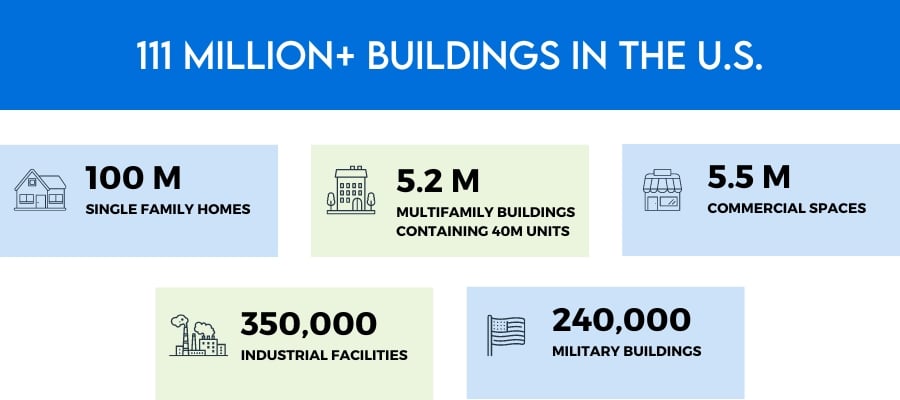
111 million buildings stand throughout the country’s more than 3.5 million square miles (and new construction projects keep that number ticking upward).
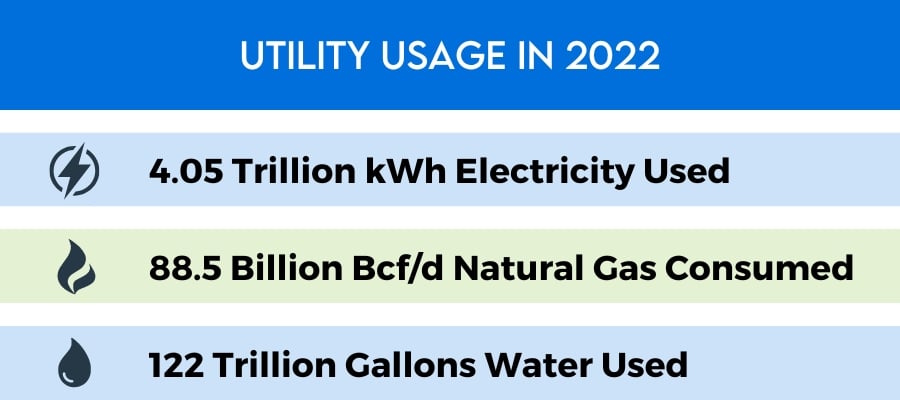
These buildings consumed 4.05 trillion kWh of electricity in 2022, and according to the U.S. Energy Information Administration, “U.S. natural gas consumption averaged a record 88.5 billion cubic feet per day (Bcf/d). And while a mere 0.5% of the earth’s water is used by humans, the United States utilized 122 trillion gallons of water last year – enough water to fill 185 million olympic size swimming pools to the brim.
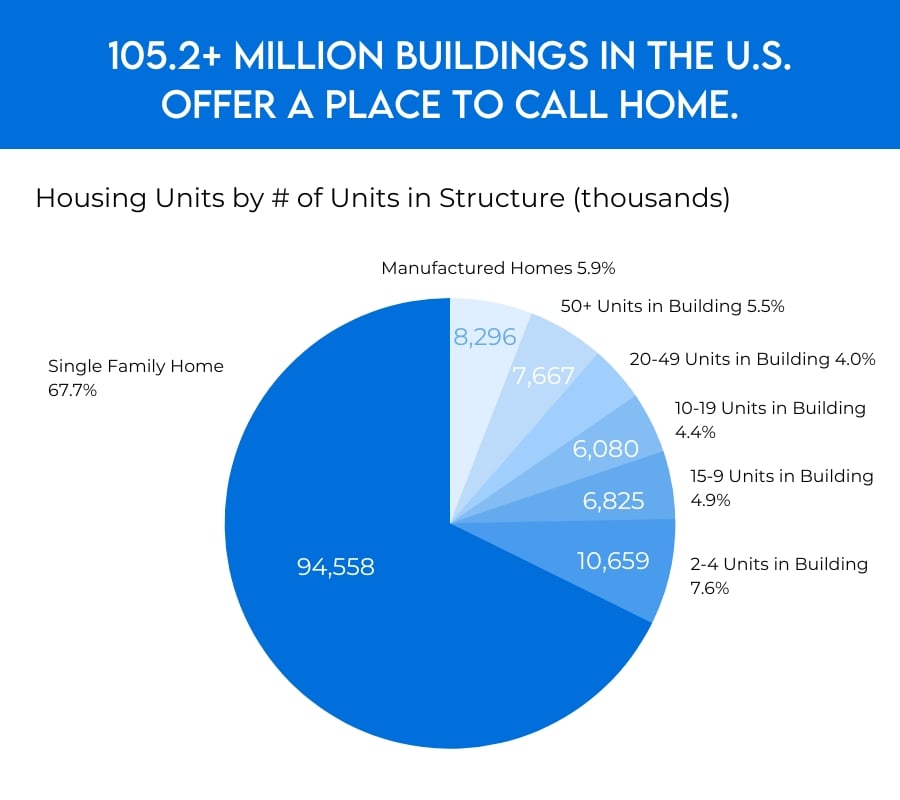
Over 334 million Americans rely on the enormous scale of utilities lifeblood to power buildings that in turn support every aspect of our lives: to live safely and comfortably at home, to work, meet basic needs and wants, even to find healing. It’s how our children are educated in environments that foster learning that propel them into the world.
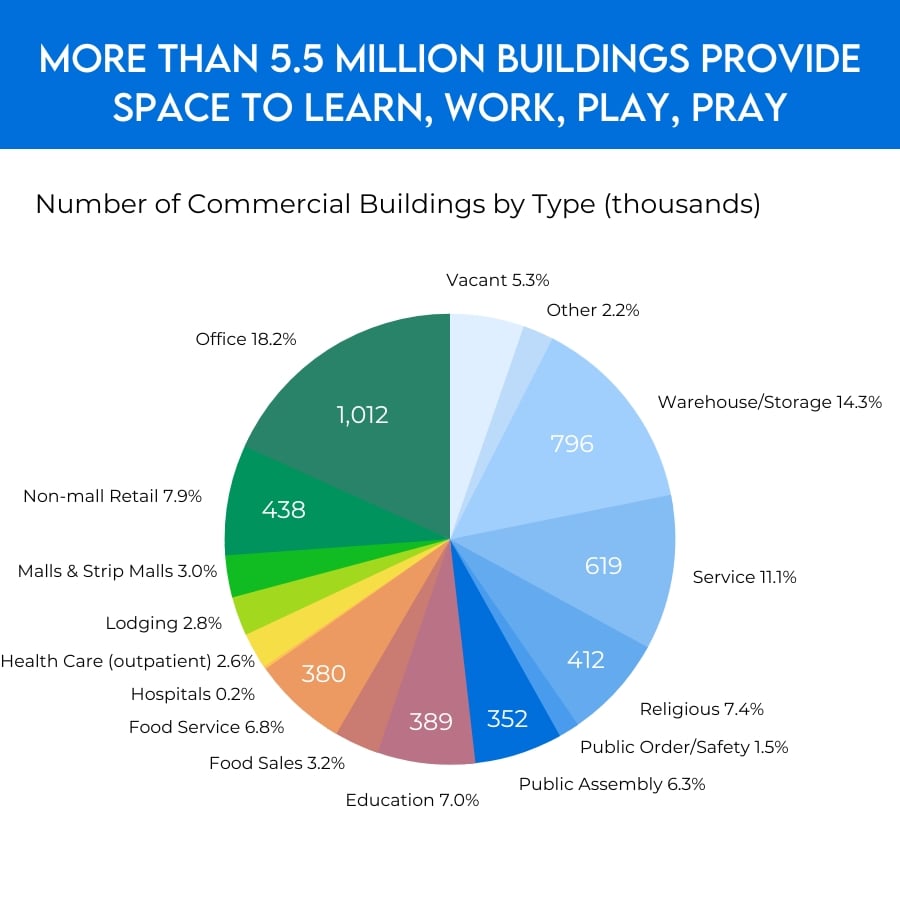
If each building in the United States requires the minimum average of 3-6 utility services, consider that more than 550 million service points support the beating heart of American infrastructure.
The millions and millions of utilities sustain the heartbeat of modern society. And they provide an overwhelming wealth of data to strategically improve sustainability.
So how do building owners and investors guarantee utilities are optimized, keeping the proverbial heart of buildings pumping with lifeblood?
A Lifeblood Infusion – Managed Utilities
While utilities give life to our buildings, they don’t consume the daily thoughts of most. Humanity operates with functioning utilities as a guarantee. And when disrupted, so is the efficiency of daily life.
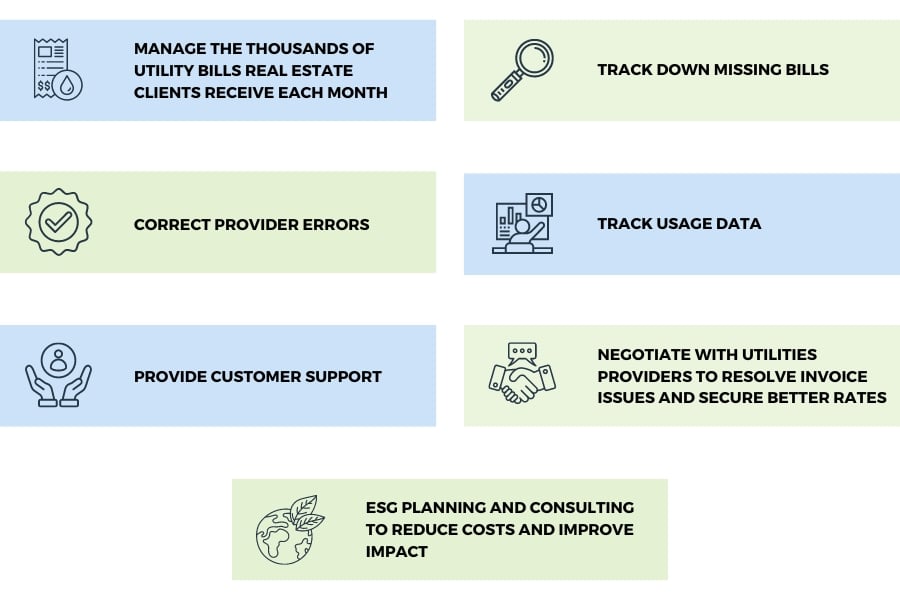
Managed utilities, our new term for a decades-old service, refers to a partner who manages utilities on behalf of other businesses. A managed-utilities provider handles everything from bill collection to payment processing and data analysis. Automation technology and dedicated expertise infuse insights that support utility savings and time that most property owners and managers can’t allocate to utilities resuscitation.
As the real estate industry’s leading managed utilities provider, utilities are the heart of what we do.
Beyond the Beating Heart – ESG
As blood flows through veins and arteries, and utilities give life to buildings, what is more important than the flow of productivity and efficiency?
Longevity. Health. Sustainability.
Enter ESG – the solution to protecting the quality of a building’s lifeblood, and more importantly, the earth. ESG, which stands for Environmental, Social, and Governance, creates a framework for organizations to utilize utility data to understand and measure opportunities to improve the lifeblood of buildings.
The scope of utilities in the U.S. is remarkable. So imagine the unbelievable impact even incremental changes would incur.
Buildings possess a vibrant lifeblood that breathes life into their structure and purpose, but it’s our job to ensure longevity through ethical and sustainable strategies.
Utilities – The Conservice Lifeblood
Utilities flow through buildings like lifeblood, delivering the vital energy, water, and services that sustain its functionality, productivity, and overall well-being.
As the Utility Experts, we partner with real estate owners and managers to conserve resources and reduce costs through our software-enabled utility management services. Utility expertise and dedication to people are our own life blood.
Better buildings mean better businesses, and in turn a better world.



Subscribe To Our Blog Newsletter
Keep yourself ahead of the curve with the latest utility news, trends, & resources.
Editor's Picks

Good Data In, Good Data Out: The Key To Turn Season
It’s that time of year again for student housing. Move-outs are piling up nearly as fast as move-ins and student housing operators and property teams have just a few short weeks to get it all sorted before the next wave…

Improving Resident Experience Through Connectivity: 4 Reasons Bulk Internet Actually Works
Multifamily owners and operators are rethinking how connectivity is delivered. Bulk internet programs are becoming an increasingly valuable solution.

Conflict in Iran Affects Utility Costs
The situation in Iran is already having measurable economic effects. While much of the attention has focused on geopolitical implications, the financial impact on consumers is becoming increasingly clear. At the time of this publication, U.S. consumers have absorbed an…

A Practical Way to Prioritize Climate Risk Across Your Portfolio [Rent at Risk: Part 3]
Climate risk analysis produces a long list of exposures across assets and markets, but it does not always produce a clear path forward. How should you leverage and prioritize available data?

Utility University: March 2026
Utility costs are rising but this isn’t just another temporary spike. From increasing energy demand to the growing role of internet as essential infrastructure, the utility landscape is evolving fast. Here’s what property teams need to know to stay ahead.

The ROAD to Housing Act: What It Means for Supply, Renters, and Operators
The Senate passed the ROAD to Housing Act on March 12 with an 89-10 vote. That kind of margin is rare, especially for something as complex as housing policy. On paper, that kind of support should signal momentum. In reality, it highlights something more interesting.

What 650 Property Audits Revealed About Utility Rate Misalignment
Most utility bills are treated as a given. They arrive, they’re processed, and they’re paid. In some cases, they’re allocated or passed through to residents, but structurally, they are rarely questioned. Utilities tend to sit in the category of “fixed”…

The 8 Climate Hazards Multifamily Investors Should Be Screening For [Rent at Risk: Part 2]
Some hazards create gradual operational pressure. Others introduce the potential for sudden, high-impact loss events. Some are widespread across nearly every region. Others are highly concentrated geographically but carry larger financial consequences when they occur. Understanding those differences is critical when screening portfolios. Because not all climate hazards carry the same implications for multifamily performance.

Vacant Cost Recovery (VCR): The Complete 2026 Guide
Utility billing doesn’t always line up cleanly with move-ins and move-outs. When it doesn’t, properties often end up covering costs that belong to residents. This article walks through how Vacant Cost Recovery helps catch those gaps and recover what would otherwise be lost.

New Rules. Same Old Trash. Ask an Expert with Tedd Schonsheck
Meet Tedd Schonsheck: Waste strategist. Former Army officer. Recovering retail executive. Now, he’s one of the people dedicated to making sure trash actually works for property owners and managers.
Experience Effortless Utility Management and Cost Savings
Connect with us today to discover how our solutions can ease tenant billback, streamline utility management, and reduce your costs and energy usage. Make your utility management smarter and more efficient with Conservice!