
What happens when more than two thousand property management professionals share their insights, experiences, goals, and anxieties in one focused census?
You get the NAA Pulse Survey.
At the end of August, National Apartment Association (NAA, a multifamily industry pillar for the uninitiated) published its 2023 Property management Industry Pulse. It’s an annual staple for anyone invested in the current and future trends of the multifamily industry, and this year’s survey uncovered a great deal about the direction our collective businesses are taking and the shifts we’ve seen in the 18 months since their last Industry Pulse.
The New Worry King? Operational Efficiencies
From the survey’s headline to its opening salvo of insights, anxieties and intentions around operational efficiency have officially become the number one issue on property manager’s minds. While operational efficiency has always been a top multifamily industry challenge, this year’s census results supplanted HR, staffing, and recruitment from the 2021 survey. It’s not especially surprising, given that fears around a U.S. recession have measurably dampened enthusiasm for hiring throughout our industry and rising interest rates have already put a squeeze on profitability. In fact, according to the census, maximizing revenue and profits rose to #2 among the surveyed challenges.
Our take? It’s a noteworthy (if contradictory) set of challenges. There’s an inherent friction between property managers striving to achieve more efficient operations and maximize profitability while also slowing down or outright freezing hiring. To meet their goals in a climate of slowed growth, property managers are going to have to find new and better ways to do more with less.
As a concept, “operational efficiencies” is a catchall that can mean very different processes and business goals. According to NAA’s survey, the most challenging activity related to operational efficiency in 2023 was reducing costs. In fact, 57% of respondents rated this as their most difficult obstacle. While that result is in no way surprising, the other contenders for most difficult aspects of operational efficiency were actually quite nuanced:
- Finding high quality vendors and suppliers (41%)
- Tracking projects and vendors/suppliers effectively (40%)
- Freeing up their teams from labor-intensive processes (40%)
*Graphs created by Appfolio
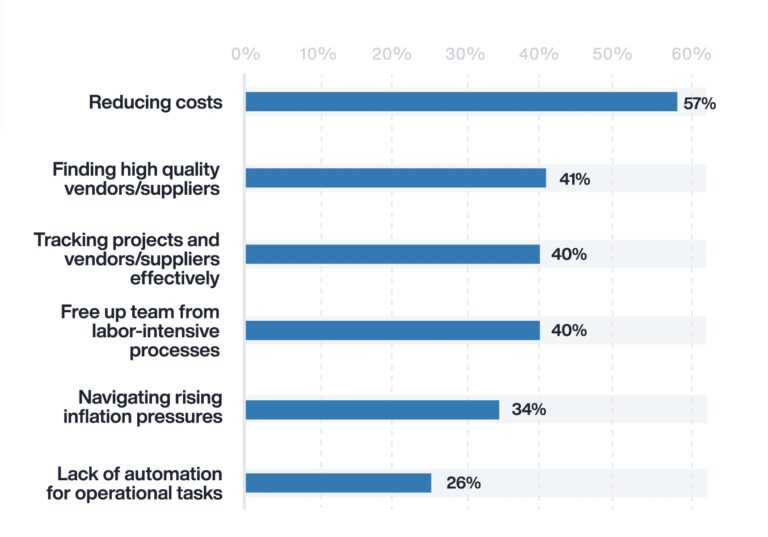
These results tell a clear and insightful story: property managers, constrained in hiring and pressured to operate more efficiently, are turning more and more to outsourced work and suppliers. And while saving on employee salaries and benefits can be a definite boon, the industry is also learning that managing vendor services can be detrimentally time-consuming and labor intensive. The TLDR; property managers need a way to relieve their teams of time-consuming tasks that lessen the load on their staff and allow them to work more seamlessly with partners.
Anxiety King Runner Up? Maximizing Revenue and Profits
The second most prominent concern for the multifamily industry also had a lot to teach us about the shifting behaviors and pressures from residents. It’s breakdown of sub challenges?
- Navigating rising inflation pressures (47%)
- Increasing occupancy rates (39%)
- Retaining current tenants (37%)
*Graphs created by Appfolio
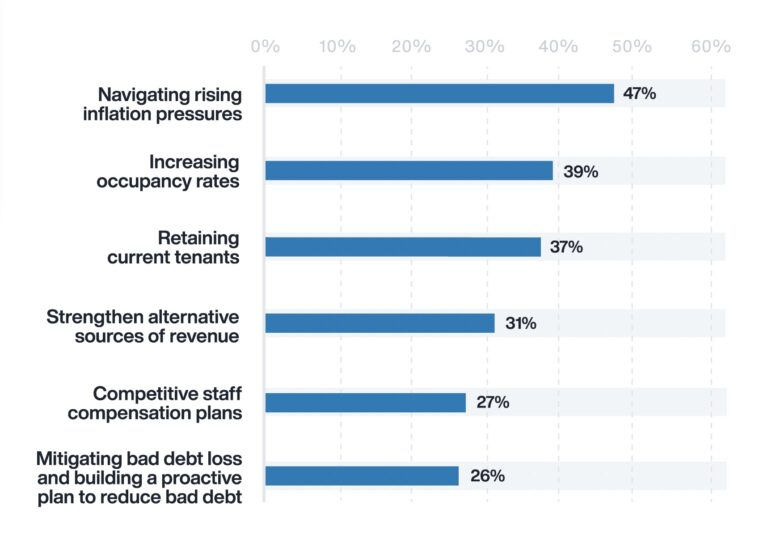
The unprecedented year-over-year hikes we’ve seen in multifamily rent appear to have all but stalled out. Where just last year some of our clients were lauding almost 20% upticks in annual rent growth, we’ve already seen a massive rise in the number of concessions that complexes are leveraging to remain regionally competitive. It’s an effective strategy, but it also has a short runway. There are only so many fiscal concessions businesses can make before they start to dip into the red.
While there is little that anyone in the industry can do to directly affect inflation, creating value for residents without cutting into profits will be the name of the game in 2024. Many of the concessions we’re seeing are knee-jerk reactions and time-honored ways of drawing in residents (first month free, waving pet fees, etc.). But for long term success in a hazardous economy, organizations will have to take an analytical approach to investing in new features and services for tenants, choosing only those that will deliver a measurable, positive ROI.
When Hiring Slows, Having the “Right” Staff Matter Most
The spread for HR in the survey reveals a hiring world that’s on fire. Even as hiring has slowed, the mechanisms around hiring have become more important than ever.
- Attracting new team members (57%)
- Training new hires quickly (52%)
- Retention strategies to reduce staff turnover (45%)
*Graphs created by Appfolio
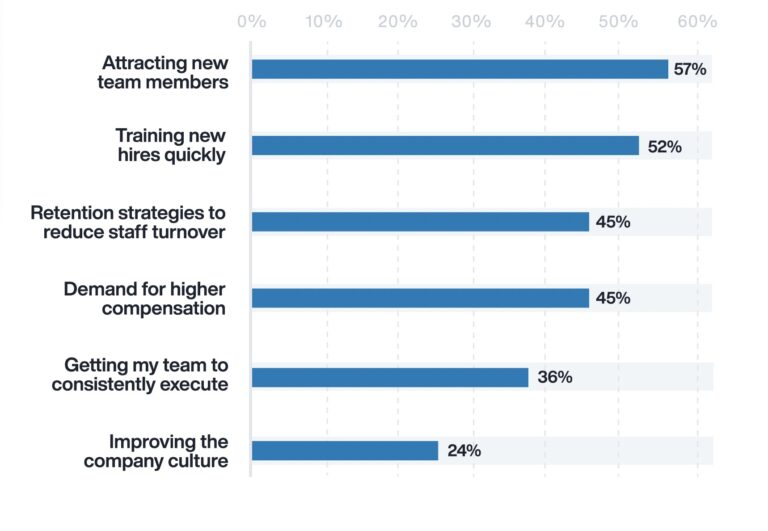
The contradictory pressures inflicted by COVID appear to have sent aftershocks in the intervening years: where just two years ago we were enduring a market where entry and mid-level management positions were quitting enmasse, we now have an environment where chilled hiring policies have upped the pressure to 1) retain the knowledge base and expertise your business already has an 2) enhance the quality and efficiency of what few new hires become available.
So in a recession-anxious economy where workers are happier than ever to land a stable position, what resistance are property managers running into when bringing on new staff?
Boring, redundant work. Recession aside, census after census over the last year has shown that employees in all strata of their career progression expect a higher quality and sophistication of day-to-day tasks than ever before. Multifamily firms that can offer their staff more challenging and stimulating work will be strongly positioned to poach talent and attract the best potential candidates. It’s why more and more multifamily businesses of all sizes are turning to automation to lower the amount of tedious or repetitive work inflicted on their employees–from chatbots filtering prospective residents to managed-utility services handling bill payments and resident billback.
The Best of the Rest? Other Noteworthy Findings
Here, we’ll provide a quick snapshot of the major obstacles the survey reviewed, their respective breakdowns, and a few accompanying thoughts and insights.
Stakeholder Experience
The top challenges were resident satisfaction (61%) and improving response time to residents (35%).
OUR TAKE? In this industry, resident satisfaction and resident response time are DEEPLY connected issues. Considers investing in 24/7 chatbot services to provide rapid responses to resident inquiries or managed utility services with dedicated resident support teams.
Risk/Compliance/Regulatory
The top surveyed challenges included “staying compliant amid constant new regulation” (61%) and “mitigating the increasing costs and burdens of regulations” (41%).
OUR TAKE? This ones a doozy. By every qualified measure, all forms of property regulations from “simple” ESG reporting requirements to robust building performance standards are slated to rise alongside the growing severity of fines. All salesmanship and marketing aside, we STRONGLY recommend partnering with vendors that provide regulatory coverage and compliance as an integral part of their service. And on the ESG front, consider a full stack solution that will give your business everything from automated, pre-formatted ESG reports to full blown consulting guidance on critical retrofits and upcoming regulations.
Altogether, the NAA Pulse Survey has once again functioned as a pillar source for understanding, predicting, and navigating the multifamily industry. Operational efficiencies have taken the forefront as a concern that all of us, vendors and complexes together, are dealing with. As the pressures of a difficult economy settle in, maximizing cost savings and protecting your employee knowledge base will become increasingly crucial.



Subscribe To Our Blog Newsletter
Keep yourself ahead of the curve with the latest utility news, trends, & resources.
Editor's Picks

Navigating Today’s Connectivity Landscape with Nic Arri
Navigating Today’s Connectivity Landscape with Nic | RSS.com The connectivity landscape is getting more complex, and multifamily owners and operators have some big decisions to make. We sat down with Nic Arri, Vice President of Solutions Consulting at Conservice, to…
Broadband & Beyond with Kevin Donnelly
Broadband & Beyond with Kevin Donnelly | RSS.com What’s next for broadband in multifamily? We sat down with Kevin Donnelly of the Real Estate Technology and Transformation Center (RETTC) to discuss the evolving landscape of multifamily connectivity. They explore the…
The Utility Partnership Playbook with Jeff Smedley & Scott Hines
The Utility Partnership Playbook with Jeff Smedley | RSS.com Who manages the utilities at a senior living community? Often, it’s a business manager or bookkeeper who is also juggling resident enrollment, retention, and day-to-day community operations. Lauren Howard sits down…

Utility Theft Detection: Protecting Revenue with Smart Monitoring
What does a case of “utility theft” even look like? A broken meter? A cyber attack? Someone hotwiring an electric panel like it’s some kind of car? Utility theft is a broad term for a simple concept—the loss of recoverable…

The Only 5 Utility Management Companies Worth Considering in 2026
The multifamily utility market has no shortage of providers. But only a handful offer the scale, service depth, technology, or specialization to deserve serious consideration in 2026. Five stand out: Conservice (unashamed plug, but true is true), RealPage, Yardi, Entrata,…

Why Should You Centralize Your Utility Management?
TL;DR Ever hear the saying “you need to get your ducks in a row”? That can be a difficult ask when those ducks are running in different directions, across multiple states. Some are even hiding from you, with a few…

Broadband Summit 2026 Debrief: The Infrastructure of Connectivity
Telecom strategy used to be limited to a few baseline questions: Who is the provider? What speeds do they offer? And are they offering the best rate? That was often the extent of the decision-making process. Walking out of Broadband…
Scaling Senior Living with Justin Brady
Scaling Senior Living with Justin Brady | RSS.com Who manages the utilities at a senior living community? Often, it’s a business manager or bookkeeper who is also juggling resident enrollment, retention, and day-to-day community operations. Lauren Howard sits down with…

Rental Junk Fee Laws in 2026: What Utility Billing Teams Need to Know
TL;DR: Fee transparency law is tightening in 2026, and most of the new rules target disclosure, not the formulas billing teams use to calculate a utility bill-back. This guide breaks down what counts as a junk fee, where disclosure rules…

Conservice’s 2nd Annual 5K Brings Together More Than 500 Participants and Gives Back to Cache Valley
LOGAN, Utah — September 10, 2026 — Conservice celebrated its second annual 5K Fun Run on September 9, bringing employees, families, and community partners together for an afternoon of connection and giving back. More than 550 people registered for this…
Experience Effortless Utility Management and Cost Savings
Connect with us today to discover how our solutions can ease tenant billback, streamline utility management, and reduce your costs and energy usage. Make your utility management smarter and more efficient with Conservice!