
At October’s Rent Manager User Conference, a speaker asked a room of property management professionals a simple question:
“How many of you track the late fees you’re paying on utility bills?”
In a room packed with dozens and dozens of manufactured housing, multifamily, and single family property managers and owners, only a handful of hands went up.
It was a conference (like so many conferences this year) that was buzzing about the potential of artificial intelligence. But that moment? When so many hands remained solemnly unraised? It underscored a key takeaway from the conference as a whole:
Many of our industry’s most impactful opportunities are hiding in processes that need to be enhanced and supported—not replaced.
Before asking what AI can do for a portfolio, operators might benefit from a more immediate question: What should already be happening automatically, repeatably, and reliably?
Efficiency Has Become a Financial Imperative
The economics of rental housing have changed. During one of this year’s Rent Manager User Conference (RMUC), manufactured housing panels, one operator described how a higher cost of capital has made operational performance far less forgiving. When financing was cheap, they argued, inefficiency had more room to hide. Today, every avoidable expense places additional pressure on returns.
That concern is reflected in Deloitte’s 2027 Commercial Real Estate Outlook. Its survey of 950 real estate executives ranked capital costs, capital availability, and interest rates among their top concerns. The outlook emphasizes disciplined investment in an environment with less room for indiscriminate spending.
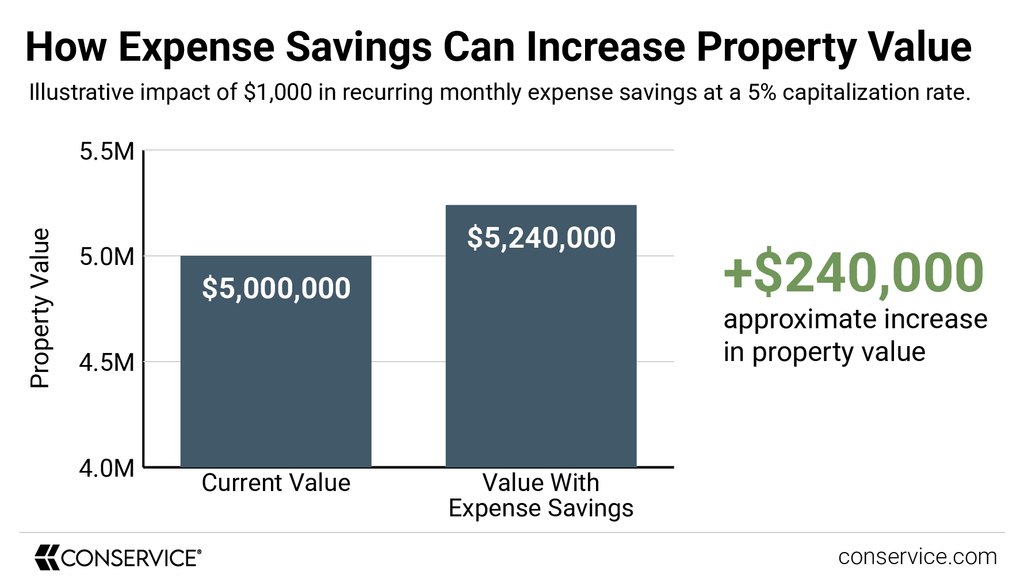
The math makes the stakes visceral. At an illustrative 5% capitalization rate, eliminating $1,000 in recurring monthly expenses could represent approximately $240,000 in property value, assuming those savings increase net operating income and the cap rate holds. Overlooked fees, redundant labor, and uncorrected billing errors can have consequences well beyond their individual line items.
Automation and AI Solve Different Problems
Across several sessions at RMUC, a broader theme emerged beneath the excitement surrounding AI: improving operations starts with understanding the work itself.
- Some workflows call for intelligence and context
- Some workflows need a dependable, repeatable process.
Automation is valuable precisely because it’s predictable. Given a defined rule and reliable input, a well-designed workflow performs the same action consistently. It routes invoices, enforces approvals, tracks deadlines, and flags exceptions without requiring someone to remember the next step.
AI, on the other hand, adds another layer. It can identify patterns across complicated datasets, interpret unstructured information, and help operators investigate questions they might never have known to ask. But AI can also produce inconsistent or inaccurate results, which means its responsibilities and safeguards need to be deliberately designed.
It’s not an absolute distinction, of course. AI can absolutely be incorporated into automated workflows, and the two technologies are often more valuable together.
What matters is understanding which tasks require consistency, which benefit from intelligent analysis, and which demand human judgment.
For property managers contending with the market forces discussed throughout RMUC, that’s a deeply practical distinction. A payment deadline shouldn’t depend on an AI model making a fresh decision every month. But an AI-powered analysis of years of payment and consumption data might uncover an emerging problem that conventional rules have missed.
McKinsey’s 2026 State of AI survey found that nearly nine in ten respondents reported regular AI use in at least one business function, yet only 37% reported positive enterprise-level EBIT impact. Nearly three-quarters of AI high performers reported fundamentally redesigning workflows, compared with just one-quarter of other respondents.
Those findings don’t establish that workflow redesign alone produces better financial results. But they DO reinforce an important idea we saw through the conference: there’s a difference between deploying technology and changing how work gets done.
Introducing AI into an inefficient process doesn’t automatically make the process better. It may simply make the inefficiency more technologically sophisticated.
Make Room for the Work That Matters
Again and again, across the five sessions we attended, speakers, panelists, and even audience discussion continued to circle the idea that emerging technologies’ chief priority should be giving property teams more time to do the work that requires people: solving unusual problems, exercising judgment, helping residents, and building relationships with owners.
Which tasks should happen the same way every time? Where would smarter analysis genuinely change a decision? And where does a human need to remain accountable?
We’re not arguing that property owners and managers have to choose between automation and AI. We’re insisting, as pioneers in automation and AI-supported workflows ourselves, that they should understand their goals well enough to know where each can make a difference.
AI will undoubtedly continue to expand what’s possible in property management. But operators don’t need to wait for the next breakthrough to improve the fundamentals. There’s tremendous value in making the routine reliable, the exceptions visible, and the data useful.
The next time someone asks a room of property managers whether they’re tracking utility late fees, knowing the answer will be progress.
Having fewer late fees to count will be the payoff.
Ready to put these ideas to work in your utility operations? Connect with a Utilty Expert to learn how our AI-powered technology and dedicated utility expertise will help your team stay ahead of the daily workload.



Subscribe To Our Blog Newsletter
Keep yourself ahead of the curve with the latest utility news, trends, & resources.
Editor's Picks

More Doors = More Moving Parts: Growing Utility Management with Your Portfolio
More Doors = More Moving Parts: Growing Utility Management with Your Portfolio It’s alive! The multifamily market is alive! The industry’s biggest property managers have developed a serious appetite for growth. This year’s rankings show just how many doors they’ve added.…

The State of Manufactured Housing in 2026
The State of Manufactured Housing in 2026 | RSS.com In 2024, we said manufactured housing was parking itself at the intersection of innovation and resilience. Two years later, the industry has A LOT more traffic to manage. Demand for manufactured…

Navigating Today’s Connectivity Landscape with Nic Arri
Navigating Today’s Connectivity Landscape with Nic | RSS.com The connectivity landscape is getting more complex, and multifamily owners and operators have some big decisions to make. We sat down with Nic Arri, Vice President of Solutions Consulting at Conservice, to…
Broadband & Beyond with Kevin Donnelly
Broadband & Beyond with Kevin Donnelly | RSS.com What’s next for broadband in multifamily? We sat down with Kevin Donnelly of the Real Estate Technology and Transformation Center (RETTC) to discuss the evolving landscape of multifamily connectivity. They explore the…
The Utility Partnership Playbook with Jeff Smedley & Scott Hines
The Utility Partnership Playbook with Jeff Smedley | RSS.com Jeff Smedley sits down with Scott Hines of Mark-Taylor Residential for a candid look at what’s shaping multifamily today. They discuss Scottsdale market conditions, multifamily financing, the complexity behind utility management,…

Utility Theft Detection: Protecting Revenue with Smart Monitoring
What does a case of “utility theft” even look like? A broken meter? A cyber attack? Someone hotwiring an electric panel like it’s some kind of car? Utility theft is a broad term for a simple concept—the loss of recoverable…

The Only 5 Utility Management Companies Worth Considering in 2026
The multifamily utility market has no shortage of providers. But only a handful offer the scale, service depth, technology, or specialization to deserve serious consideration in 2026. Five stand out: Conservice (unashamed plug, but true is true), RealPage, Yardi, Entrata,…

Why Should You Centralize Your Utility Management?
TL;DR Ever hear the saying “you need to get your ducks in a row”? That can be a difficult ask when those ducks are running in different directions, across multiple states. Some are even hiding from you, with a few…

Broadband Summit 2026 Debrief: The Infrastructure of Connectivity
Telecom strategy used to be limited to a few baseline questions: Who is the provider? What speeds do they offer? And are they offering the best rate? That was often the extent of the decision-making process. Walking out of Broadband…
Scaling Senior Living with Justin Brady
Scaling Senior Living with Justin Brady | RSS.com Who manages the utilities at a senior living community? Often, it’s a business manager or bookkeeper who is also juggling resident enrollment, retention, and day-to-day community operations. Lauren Howard sits down with…
Experience Effortless Utility Management and Cost Savings
Connect with us today to discover how our solutions can ease tenant billback, streamline utility management, and reduce your costs and energy usage. Make your utility management smarter and more efficient with Conservice!