
In the first two articles in this series, we built the foundation for how multifamily teams should approach physical climate risk. In Part 1, we established that climate risk now plays a role in portfolio allocation decisions. In Part 2, we explored how different hazards behave and why they affect performance in different ways.
At that point, most portfolios arrive at the same place. Exposure is visible, and the types of risk are understood. What remains unclear is where to focus next.
Climate risk analysis produces a long list of exposures across assets and markets, but it does not always produce a clear path forward. How should you leverage and prioritize available data?
Exposure Alone Falls Short
When you look at exposure at the asset level, nearly every property shows some level of risk. In our analysis of more than 3,400 investment-grade multifamily properties, every asset was exposed to at least one hazard, and most were exposed to several. That result reflects how widespread physical climate risk has become, but it does not help you decide where to act.
Exposure answers a binary question. It tells you whether risk exists. It does not tell you how much that risk matters.
This is where exposure lists lose their usefulness. They identify risk, but they do not help you decide what to do about it.
Bringing Value Into the Equation
Exposure needs context in order to move from identification to prioritization.
In Rent at Risk, we introduced that context by assigning each asset a consistent estimate of value using market-level inputs. This creates a comparable baseline across markets, allowing exposure to be evaluated in financial terms rather than as a simple yes-or-no condition.
Once value is introduced, exposure can be scaled. A larger asset exposed to multiple hazards carries more weight than a smaller asset with similar conditions. Exposure begins to reflect scale and not just presence.
At that point, another distinction becomes important. Not all hazards carry the same financial implications. A property exposed to hurricane risk faces a different set of potential outcomes than one exposed to temperature variability. To account for that, hazards can be grouped into tiers and weighted accordingly. Higher-impact risks are treated differently from more moderate ones, which creates a more realistic view of exposure without relying on complex modeling.
The result is a structured way to compare exposure across assets using a consistent financial lens.
How Prioritization Actually Happens
Now, prioritization becomes a question of alignment. If exposure follows the same pattern as asset value, risk is likely distributed as expected.
A market that represents a modest share of portfolio value may account for a much larger share of exposure. An individual asset may carry more risk than its size would suggest. These imbalances are what signal where attention should be directed.
What the Data Shows at Scale
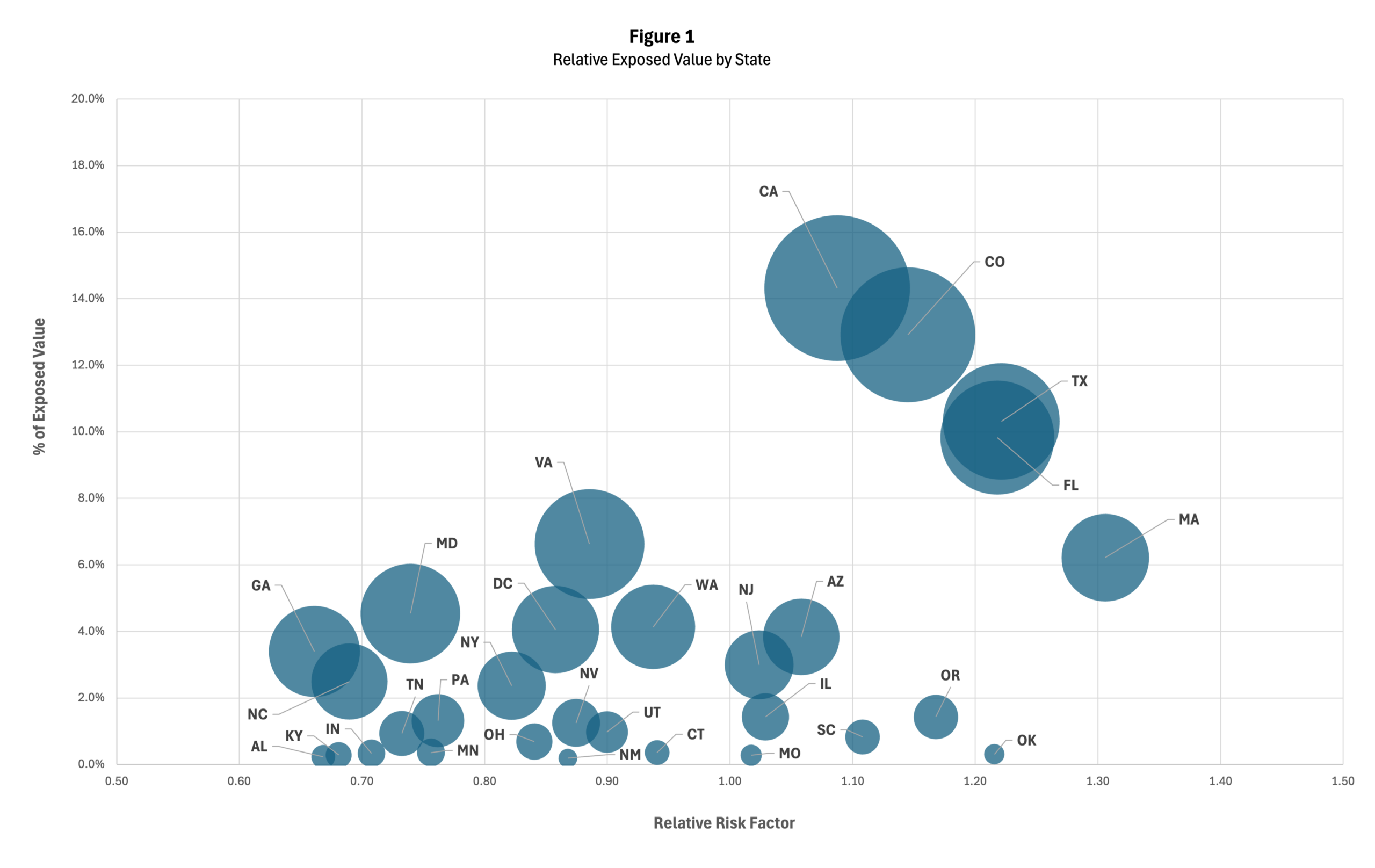
When the approach above is applied across a large population of multifamily assets, certain patterns become clear.
Exposure tends to concentrate in specific markets where multiple hazards intersect with higher asset values. Some regions stand out because of the types of risks they face. Others emerge because of how capital is distributed within a portfolio. The result is not a short list of “safe” or “unsafe” markets.
That is the level of insight needed to move from awareness to action.
Application at the Portfolio-Level
The same logic applies within a single portfolio. When exposure is mapped against value, a small number of assets often emerge as priority candidates for deeper analysis. These properties tend to sit at the intersection of higher exposure and higher portfolio significance.
Now teams can focus their efforts. Instead of applying the same level of analysis across every asset, attention can be directed where it will have the most impact.
Rent at Risk: Assessing Physical Climate Risk in Multifamily Investments applies this framework across a large set of investment-grade properties, showing how exposure distributes and where it concentrates.



Subscribe To Our Blog Newsletter
Keep yourself ahead of the curve with the latest utility news, trends, & resources.
Editor's Picks

Don’t Mistake AI for Automation: A Primer for Property Management
At October’s Rent Manager User Conference, a speaker asked a room of property management professionals a simple question: “How many of you track the late fees you’re paying on utility bills?” In a room packed with dozens and dozens of…

More Doors = More Moving Parts: Growing Utility Management with Your Portfolio
More Doors = More Moving Parts: Growing Utility Management with Your Portfolio It’s alive! The multifamily market is alive! The industry’s biggest property managers have developed a serious appetite for growth. This year’s rankings show just how many doors they’ve added.…

The State of Manufactured Housing in 2026
The State of Manufactured Housing in 2026 | RSS.com In 2024, we said manufactured housing was parking itself at the intersection of innovation and resilience. Two years later, the industry has A LOT more traffic to manage. Demand for manufactured…

Navigating Today’s Connectivity Landscape with Nic Arri
Navigating Today’s Connectivity Landscape with Nic | RSS.com The connectivity landscape is getting more complex, and multifamily owners and operators have some big decisions to make. We sat down with Nic Arri, Vice President of Solutions Consulting at Conservice, to…
Broadband & Beyond with Kevin Donnelly
Broadband & Beyond with Kevin Donnelly | RSS.com What’s next for broadband in multifamily? We sat down with Kevin Donnelly of the Real Estate Technology and Transformation Center (RETTC) to discuss the evolving landscape of multifamily connectivity. They explore the…
The Utility Partnership Playbook with Jeff Smedley & Scott Hines
The Utility Partnership Playbook with Jeff Smedley | RSS.com Jeff Smedley sits down with Scott Hines of Mark-Taylor Residential for a candid look at what’s shaping multifamily today. They discuss Scottsdale market conditions, multifamily financing, the complexity behind utility management,…

Utility Theft Detection: Protecting Revenue with Smart Monitoring
What does a case of “utility theft” even look like? A broken meter? A cyber attack? Someone hotwiring an electric panel like it’s some kind of car? Utility theft is a broad term for a simple concept—the loss of recoverable…

The Only 5 Utility Management Companies Worth Considering in 2026
The multifamily utility market has no shortage of providers. But only a handful offer the scale, service depth, technology, or specialization to deserve serious consideration in 2026. Five stand out: Conservice (unashamed plug, but true is true), RealPage, Yardi, Entrata,…

Why Should You Centralize Your Utility Management?
TL;DR Ever hear the saying “you need to get your ducks in a row”? That can be a difficult ask when those ducks are running in different directions, across multiple states. Some are even hiding from you, with a few…

Broadband Summit 2026 Debrief: The Infrastructure of Connectivity
Telecom strategy used to be limited to a few baseline questions: Who is the provider? What speeds do they offer? And are they offering the best rate? That was often the extent of the decision-making process. Walking out of Broadband…
Experience Effortless Utility Management and Cost Savings
Connect with us today to discover how our solutions can ease tenant billback, streamline utility management, and reduce your costs and energy usage. Make your utility management smarter and more efficient with Conservice!