
The situation in Iran is already having measurable economic effects. While much of the attention has focused on geopolitical implications, the financial impact on consumers is becoming increasingly clear. At the time of this publication, U.S. consumers have absorbed an estimated $25.2 billion in additional fuel costs.
And though headlines and water cooler conversations tend to focus on the price at the gas pump, there’s a lot more to that 25.2 billion number. One of those quieter costs may become more apparent on this summer’s utility bills.
So, how does the conflict overseas translate to added utility expenses? Let’s break it down.
Critical Pressure Points in Energy
A significant portion of the world’s oil and natural gas flows through the Middle East, and any disruption—whether from sanctions, infrastructure damage, or shipping risk—creates immediate volatility in energy markets.
According to EnergySage, even the threat of disruption can drive up oil and gas prices. Markets react quickly to uncertainty, and energy is one of the most globally interconnected commodities.
The ripple effect takes over, and the result is higher price tags.
From Global Conflict to Your Utility Bill
So how exactly does a conflict thousands of miles away impact what you pay for electricity, water, and gas at home?
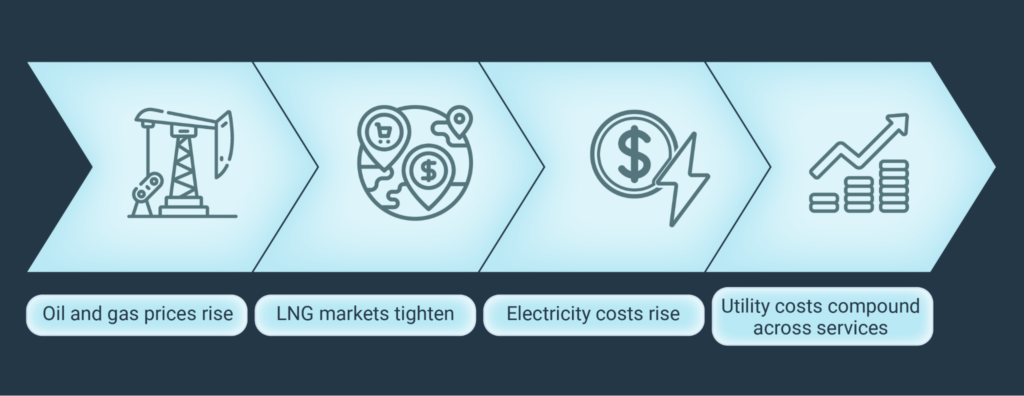
It’s a simple chain reaction:
Oil and gas prices rise
Conflict in the region puts pressure on supply chains, pushing crude oil and natural gas prices higher. As noted by Yahoo Finance, geopolitical instability often leads to immediate spikes in global energy pricing.
LNG markets tighten
Liquefied natural gas (LNG) (a key fuel for electricity generation) is especially sensitive. Disruptions in exports or shipping routes can constrain supply and increase costs worldwide. This article from Inside Climate News highlights how LNG market pressure is already translating into higher utility costs.
Electricity becomes more expensive
In many U.S. regions, electricity is heavily dependent on natural gas. In fact, natural gas accounts for over 40% of all electricity generation in the U.S., making it the single largest driver of power costs (IEA.org). When gas prices increase, utilities face higher generation costs. Property owners are especially vulnerable.
Utility costs compound across services
Water and wastewater systems are also highly energy-dependent, particularly when it comes to treatment and distribution. As energy prices increase, those higher input costs tend to flow through to the broader utility ecosystem.
What This Means for Multifamily Communities
For property owners and operators, rising costs are operational.
You may begin to see:
- Rising common area electricity costs.
- Increased pressure on utility recovery strategies (RUBS, submetering).
- Budget variance as actual utility costs outpace forecasts.
- Regional differences in impact, particularly in markets heavily reliant on natural gas.
It’s crucial to remember that these increases don’t always hit immediately. Utility pricing often lags behind shifts in underlying energy markets, meaning the impact may take time to appear on bills.
Why the Impact May Stick Around
Even if geopolitical tensions ease, energy markets don’t simply reset overnight.
- Supply chains take time to stabilize.
- Infrastructure disruptions can have long-term effects.
- Market uncertainty can sustain elevated pricing.
As a result, cost increases may persist beyond the initial disruption. As noted in Realtor.com analysis, even after a ceasefire, elevated energy prices can continue to push utility costs higher, with impacts extending into future billing cycles.
How to Protect Your Portfolio
You can’t control global conflict. But you can control how exposed you are to it.
Here’s where to focus:
1. Optimize cost recovery
Ensure your billing strategy is aligned with current cost realities so you’re not absorbing unnecessary increases.
2. Prioritize efficiency upgrades
Energy-efficient lighting, smart thermostats, and water-saving technologies deliver even greater ROI when utility costs rise.
3. Stay ahead of rate changes
Monitor utility rate cases and market signals proactively rather than reacting after increases hit your bottom line.
4. Understand your exposure
Properties in regions heavily dependent on gas-fired electricity may face more volatility. Knowing where you’re most exposed helps you plan accordingly.
5. Evaluate procurement strategies (where applicable)
In deregulated markets, procurement strategy can play a key role in managing cost volatility. Reviewing contract structures, timing, and supplier options may help minimize exposure to market swings. However, this process can be both time-sensitive and complex. Working with an experienced partner can help simplify decision-making. Learn more about how we handle this for you.
6. Leverage expertise
Utility cost forecasting and risk mitigation require dedicated focus. If you’re looking for support navigating these challenges, contact us to start the conversation.



Subscribe To Our Blog Newsletter
Keep yourself ahead of the curve with the latest utility news, trends, & resources.
Editor's Picks

Conservice’s 2nd Annual 5K Brings Together More Than 500 Participants and Gives Back to Cache Valley
LOGAN, Utah — September 10, 2026 — Conservice celebrated its second annual 5K Fun Run on September 9, bringing employees, families, and community partners together for an afternoon of connection and giving back. More than 550 people registered for this…

The How-to Guide for Reducing CAM Charges and Shared Space Costs
TL;DR When investigating where to reduce CAM charges and multifamily common-area costs, shared utility expenses might be the place to start. A higher bill doesn’t automatically signal waste, so it’s important to compare cost and consumption before deciding where to…

Installing EV Charging Stations: A Guide for Multifamily Property Owners
Have there always been this many electric vehicles on the road? It looks like the silent hum of an EV has become a roar, as Electric vehicles take the United States by storm. With the rise of EVs, comes the…
Policy Watch: Compliance & Building Readiness with Brett Kraus and Michelle Winters
Policy Watch: Compliance & Building Readiness with | RSS.com In this episode of Utility Wisdom, Michelle Winters, Vice President of Sustainability Sales at Conservice, sits down with Brett Kraus, Senior Legal Counsel, and Katie Piel, Sustainability Manager, to break down…
Conservice Earns 15th Appearance on Inc. 5000
RIVER HEIGHTS, Utah, August 14, 2026 – Conservice, the nation’s leading utility management provider, has been named to the 2026 Inc. 5000, marking the company’s 15th appearance on the annual list of America’s fastest-growing private companies. The recognition adds another…

5 Signs Your Telecom Strategy Needs An Update
Telecom has a funny way of becoming someone’s problem. A resident can’t get connected, so they call the onsite property team. A provider needs an answer, so someone digs through an old agreement. A renewal date appears on the calendar,…

How to Streamline Invoice Processing & Auditing
Utility bills have a lot to say. They can tell you where costs are climbing and where usage looks unusual. They can point to a provider error before it hits your bottom line. And across hundreds or thousands of accounts,…

Ask An Expert with Sustainability Expert, Sandra Closson
Meet Sandra Closson Some people see spreadsheets full of utility data. Sandra sees a story about how a building operates and where it can improve. With nearly three decades of professional experience and 17 years in sustainability, Sandra has built…

The Next Chapter of Single Family Operations
At some point “more” stops being the answer. The single family industry has spent the last decade defining success as growth. Build new properties, acquire existing properties, attract institutional investment, repeat. Portfolios grew from hundreds of homes to thousands. “More”…

RUBS Utility Billing vs. Submetering: A Decision Guide
RUBS Utility Billing vs. Submetering A Decision Gu | RSS.com TL;DR: Not every property gets to choose between RUBS and submetering – your building, budget, and state regulations all play a role. RUBS (Ratio Utility Billing System) is faster and…
Experience Effortless Utility Management and Cost Savings
Connect with us today to discover how our solutions can ease tenant billback, streamline utility management, and reduce your costs and energy usage. Make your utility management smarter and more efficient with Conservice!